David Tanner, whose portrait of the artist at work caught my eye on Pinterest a little while back:
(#1) Model Break (2016), which attracted my attention for its interest in the male body, also because it’s an example of modern representational painting by a serious artist, in one of the forms (portraiture) where this traditional approach flourishes (other such forms: still lifes, nudes, landscapes, and magic realism and fantasy — all of which, except the last, Tanner has also taken up)
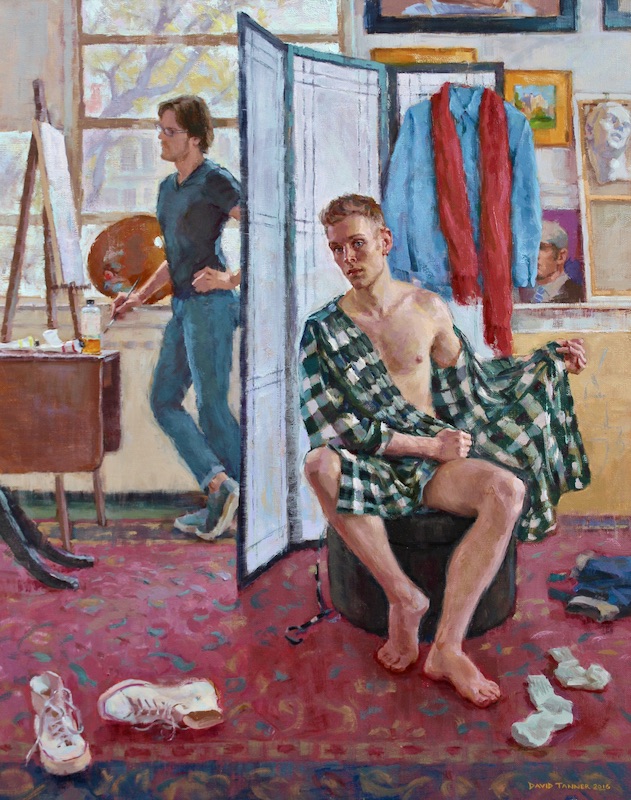
Tanner has also provided us with a detailed account, in plain language, of his development as an artist. And thrown off a passing reference to his husband, so providing some background for his attention to the male body.
He’s a prolific artist, turning out enormous numbers of paintings in the following categories (of his own devising):
scenes with male figures [especially dancers and athletes], scenes of musicians [all male], landscapes and cityscapes, scenes of Italy, scenes with female figures, Richmond Virginia [the city he lives in] scenes, scenes of artists [all male] at work, still lifes
Two further examples, and then DT in his own words.
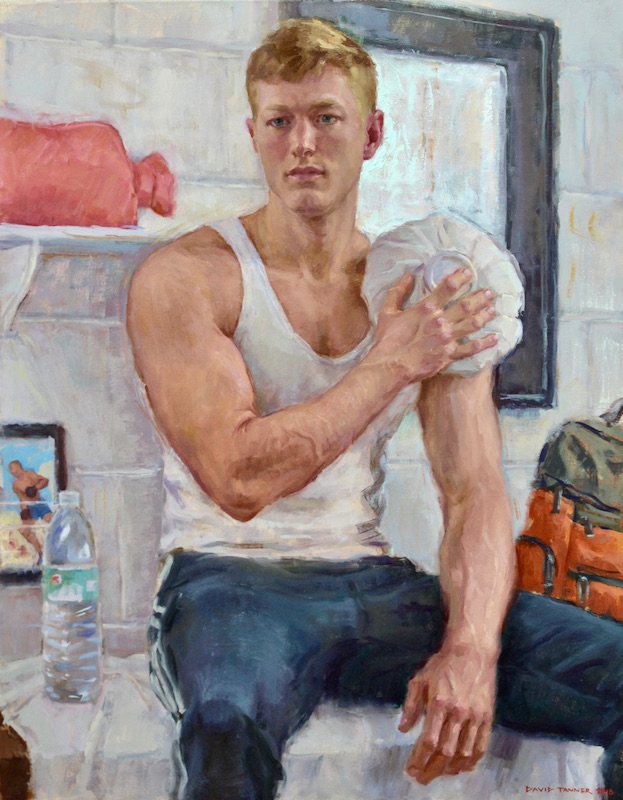
An athlete. Specifically, a boxer.
(#2) After the Match (2018)
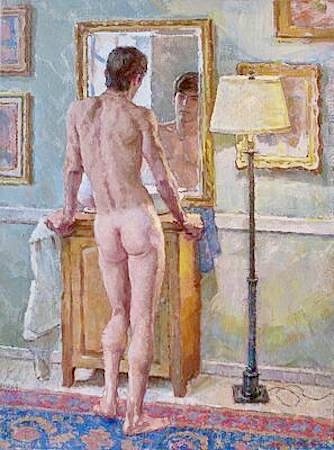
A male nude.
(#3) Reflection (2020)
Tanner on his life and work. From his David Tanner Fine Art website:
My name is David Tanner and I’m a representational oil painter. I live and work in Richmond, Virginia. My first love as a painter is depicting the human figure, but I also enjoy plein-air landscape painting and still-life. Here’s a video with an overview of my process.
Background & Training: As a kid, I loved drawing and painting, and thankfully had encouraging parents. When it came time for college, there was no question that I would study art, although what kind of art wasn’t so clear. I had never met anyone who actually made a living as an artist. So, I studied commercial illustration at Virginia Commonwealth University because it seemed like a financially viable career choice in the arts, and got my BFA degree in 1991. After graduating and getting some experience, however, I realized my heart wasn’t in commercial illustration. I wanted to be a traditional painter creating work for galleries, rather than creating ads for corporations.
In my first 10 years out of school, I waited tables while pursuing my painting. Since people were my favorite subjects, I sought commissioned portraits as a way to pay some bills and more importantly, improve my skills through practice. You see, I really didn’t have all that much basic painting instruction from VCU. They were far more interested in concepts, and less so in technique. So I was basically teaching myself post-college.
By the early 2000’s the commissioned portrait work was consistent and I no longer had to wait tables to pay the rent. And even though I was proud of what I had accomplished as self-taught painter, I knew there were many gaps in my learning. The growing atelier movement — learning from master painters in their workshop – came onto my radar, so I decided to check out some of the small painting academies that provide a traditional education in painting the human figure. This type of education was the mainstay of western art until the mid-20th century when abstraction and modernism declared that representational painting was dead.
Between 2003 and 2008, I traveled regularly to study with some superb figurative artists. A few multi-week workshops with Nelson Shanks at his Studio Incaminati in Philadelphia were critical in my development, as were weekly classes with Robert Liberace at the Art League in Alexandria, Virginia. Both teachers coupled an Impressionist approach to seeing color with an academic approach to draftsmanship. For the first time, I was learning solid principles of painting from life. In both experiences, it was gratifying to realize how much I knew already through self-teaching, but also enlightening to understand how I could improve and streamline my process.
There’s a real distinction in my work before and after my training. My work became looser after my training, but ironically more accurate than my earlier, tighter realism. I suppose I was finally learning how to say more with less.
Career: By 2007, I no longer sought commissioned portraits, and instead focused on paintings for galleries – in particular, painting people of my choosing as subjects of narrative paintings. I fell in love with staging a scene, and finding just the right model for specific themes.
Around this time, plein-air painting became a steady part of my diet. Frequent traveling provided rich opportunities for capturing the light and color of locations in Russia, Italy, Spain, Morocco, and Great Britain. Museum visits abroad gave me the chance to study the work of historic painters I admire, including John Singer Sargent, Joaquin Sorolla, Anders Zorn, Ilya Repin, and other late 19th and early 20th century masters.
Regular readers of this blog will recall my series of postings on John Singer Sargent.
Leave a Reply