That would be today’s holiday: Ferragosto! From Wikipedia:
Ferragosto is a public holiday celebrated on 15 August in all of Italy. It originates from Feriae Augusti, the festival of Emperor Augustus, who made 1 August a day of rest after weeks of hard work on the agricultural sector. [During the festivities, horse races were organized throughout the Empire and draft animals (oxen, donkeys and mules) were released from work and adorned with flowers.]
As the festivity was created for political reasons, the [Roman] Catholic Church decided to move the festivity to 15 August, which is the [feast day of the] Assumption of [the Blessed Virgin] Mary …
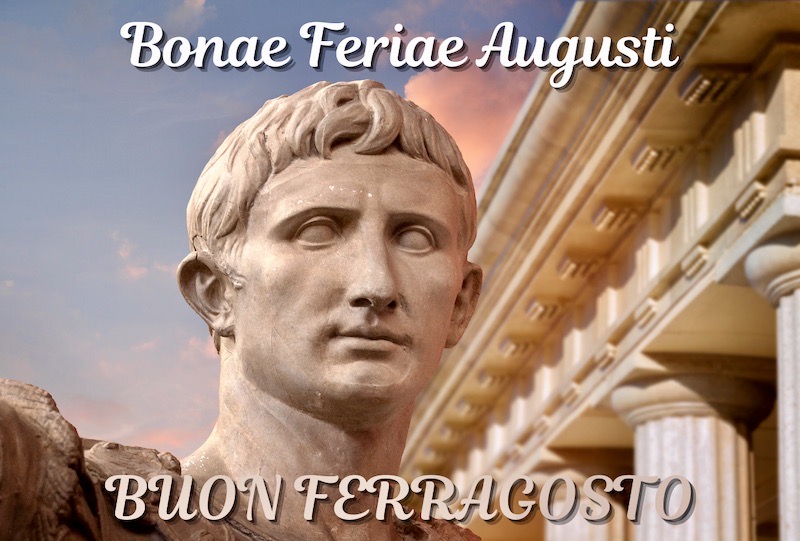
(#1) Imperial illustration from the Scuola Leonardo da Vinci website, “Ferragosto in Italy” on 8/13/21 (with holiday wishes in Latin and in Italian)
This festivity was used by Benito Mussolini to give the lower classes the possibility to visit cultural cities or go to the seaside for one to three days, from 14 August to the 16th, by creating “holiday trains” with extremely low cost tickets, for this holiday period. Food and board was not included, which is why even today Italians associate packed lunches and barbecues with this day. By metonymy, it is also the summer vacation period around mid-August, which may be a long weekend (ponte di Ferragosto) or most of August. Until 2010, 90% of companies, shops and industries closed; however, because closing an entire country’s economy for an entire month would result in serious financial impacts and workplace backlogs, most companies now close for about two weeks and require all workers to take mandatory vacation, similar to the practice of workplaces closing between 25 December and the first of January.
… The opera Pagliacci by the Neapolitan composer Ruggero Leoncavallo takes place on the day of Ferragosto (“Oh, che bel sole di mezz’agosto!”; “Per la Vergin pia di mezz’agosto!”).
Just to remind you that holidays and occasions pick up new meanings and new practices over time and in different places (and sometimes new dates as well), and not infrequently absorb elements of other holidays (from very different historical traditions).
But the middle of August could use an official R&R holiday for those of us outside Italy. Along these lines, my caregiver León gave me another visit to Palo Alto’s Gamble Garden this afternoon: a giant festival of food plants and herbs, which was lots of fun, though not bearable for long in the 86F blazing heat.
Art Bonus. Wikipedia led me, eventually, to a five-part series of Ferragosto paintings by the amazing and inscrutable Cy Twombly in 1961. One of them:
(#2) Ferragosto IV

On the artist, from Wikipedia:
Edwin Parker “Cy” Twombly Jr. (April 25, 1928 – July 5, 2011) was an American painter, sculptor and photographer.
Twombly influenced artists such as Anselm Kiefer, Francesco Clemente, Julian Schnabel and Jean-Michel Basquiat. His best-known works are typically large-scale, freely-scribbled, calligraphic and graffiti-like works on solid fields of mostly gray, tan, or off-white colors. His later paintings and works on paper shifted toward “romantic symbolism”, and their titles can be interpreted visually through shapes and forms and words. Twombly often quoted poets such as Stéphane Mallarmé, Rainer Maria Rilke and John Keats, as well as classical myths and allegories, in his works. Examples of this are his Apollo and The Artist and a series of eight drawings consisting solely of inscriptions of the word “VIRGIL”.
I don’t pretend to know what CT had in mind with most of these works (though there’s certainly a lot of sexy stuff in some of it), certainly not with the Ferragosta series. I am, however, open to ilumination.
August 16, 2024 at 6:19 am |
It just so happens that the latest addition to our household (introduced on my last birthday, in May) is an Emperor penguin, whose name, fittingly enough, is Augustus. He’s celebrating the whole month.