An Amy Hwang cartoon in the latest — 10/23 — issue of the New Yorker that I found hugely funny, for reasons I couldn’t at first explain:
(#1)

Well, there are people who can fall asleep (pretty much) anywhere, as they say — I’ve been such a person for about 70 years now — but I have never just lain down for an impromptu nap on the ground out in the world, as the snail in #1 seems to have done, preposterously.
Actually, the cartoon snail is lying flat as a flounder, in such a way that it’s hard to be sure that it’s only somnolent and not in fact deceased. It could well be not merely sleeping, but dead — reversing the customary formula, of many applicabilities, that someone or something isn’t dead, but only sleeping. Snail3 in the cartoon looks a lot like the Monty Python pet-shop parrot: this is an ex-snail, gone to meet its maker, and its snail buddies are just slip-sliding along in denial.
So #1 is wonderfully absurd. It’s also an excellent example of a cartoon existing equally in two worlds: visually, the world of snails (lacking males, since snails are generally hermaphroditic; bereft of speech; and also exhibiting dormancy but not, apparently, actual sleep); behaviorally, the world of human beings (where Snail1 can remark that he — Snail3 — can fall asleep anywhere).
But then I was carried away into the complexities of sleep in human beings and in other creatures (where it contrasts with rest and dormancy, not to mention death) and into the behavior of snails, where I will report — surprise! — on a 2011 study from the Journal of Experimental Biology about a common pond snail:
Behavioural evidence for a sleep-like quiescent state in a pulmonate mollusc, Lymnaea stagnalis (Linnaeus)
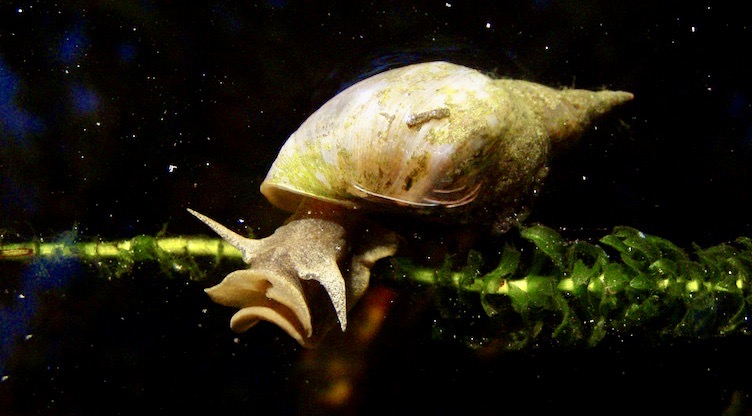
The mollusk (AmE) / mollusc (BrE) in question, the great pond snail, from Wikipedia:
(#2)
Lymnaea stagnalis, better known as the great pond snail, is a species of large air-breathing freshwater snail, an aquatic pulmonate gastropod mollusk in the family Lymnaeidae. The great pond snail is a model organism to study parasitology, neurology, embryonal development and genetic regulation
Note on the artist. One previous posting on this blog of an Amy Hwang cartoon, in “A New Yorker trio” of 10/23/20.
Falling asleep (pretty much) anywhere. And falling asleep (pretty much) instantly. Two things I’ve been able to do since my early teen years. And able to do virtually at will — to the point where I was able to put my head down or sit in a chair, or lie down, almost anywhere, and direct myself to sleep for 20 minutes, or an hour, or until I woke naturally, and then slip out of consciousness within seconds.
When I was a teenager and was unable to get a full night’s sleep, I could use these abilities to get refreshing naps during the day. Now that I’m an old man who has to whizz 4 to 7 times during the night, every night, I can use these abilities to slip back to sleep after each break. And all through these 70 years it’s been a great boon to be able to go to sleep when I wanted to, virtually immediately, even in brightly lit, noisy rooms. Abilities that astonished my college roommates.
You see that I have always viewed these two falling-asleep abilities, both under voluntary control — doing it (almost) instantly, (almost) anywhere — as great gifts. You will then appreciate my dismay when I went to the net yesterday to ask about falling asleep anywhere (in the hope of finding a name for the phenomenon) and was inundated by warnings, from many sources (including some respectable medical sources), about dangerous disorders: narcolepsy and exhaustion / sleep deprivation. And then the same for falling asleep instantly. In fact, I found absolutely no sources that treated these phenomena as routine, everyday, normal (though relatively uncommon).
Now, I have experienced sleep deprivation, exhaustion, and, oh alas, narcolepsy (as a monstrous side effect of withdrawal from prednisone, chronicled in postings on this blog), and I can report that the experiential feel of Falling Asleep Anywhere (FAA) and Falling Asleep Instantly (FAI) — which are for me entirely normal phenomena — is utterly different; but is closely related to meditation as a state of consciousness. (I am reminded, of course, of the huge body of literature on homosexualities in which these phenomena, entirely normal for me, are treated as (medical, psychological, or spiritual) disorders.)
Apparently, since the two phenomena FAA and FAI are relatively rare, the view is that they must be disorders. This is specious reasoning, pure and simple.
But nobody seems to have a name for FAA and FAI.
Sleep in animals. From Wikipedia, in an entry that notes sleep states in a wide range of creatures, softening us up for contemplating the possibility of sleep in snails:
Sleep in animals refers to a behavioral and physiological state characterized by altered consciousness, reduced responsiveness to external stimuli, and homeostatic regulation [AZ: promoting a stable equilibrium] observed in various animals. Sleep has been observed in mammals, birds, reptiles, amphibians, and some fish, and, in some form, in insects and even in simpler animals such as nematodes. The internal circadian clock promotes sleep at night for diurnal organisms (such as humans) and in the day for nocturnal organisms (such as rats). Sleep patterns vary widely among species. It appears to be a requirement for all mammals and most other animals.
Sleep is then distinct from periods of rest (mere inactivity) and also from dormancy, longer periods of suspended animation. From NOAD:
noun dormancy: 1 [a] the state of having normal physical functions suspended or slowed down for a period of time … : the insects are able to enter prolonged states of dormancy, allowing them to resist freezing …
Pond snails can enter into long periods of dormancy, even years long if the environmental conditions call for it. But the 2011 study looked at them in more ordinary circumstances.
The 2011 snail study. From the PhysOrg.com site, “First evidence of sleep in snails” by Lin Edwards on 2/18/11:
Scientists in Canada [at the University of Toronto] noticed pond snails [AZ: a standard lab animal; see above] spent around 10 percent of their time attached to the side of their tank with their tentacles partly withdrawn, their shells hanging away from their bodies, and with their feet symmetrical and relaxed. The researchers decided to do some experiments to find out if the snails were asleep or just resting, and their results provide the first evidence that gastropods sleep.
There is no single characteristic that defines sleep but sleep is deduced from a number of factors such as being unresponsive and hard to rouse, and adopting a characteristic position. To determine if their snails did sleep, Associate Professor Richard Stephenson and Dr Vern Lewis of the University of Toronto observed pond snails (Lymnaea stagnalis) in their tanks and cataloged their behavior.
The researchers reasoned that if the snails were sleeping rather than merely resting, they would respond less to stimulation and would withdraw their bodies into their shells sluggishly when prodded with a metal rod, for example. They tested the responses of active and apparently sleeping snails to being tapped on the shell, prodded with a rod, and having their appetites simulated by exposing them to sucrose solution.
The results of their experiments showed that the active snails responded twice as quickly to physical stimulation and seven times faster to appetite simulation than the immobile snails, so it appears that the resting snails were actually asleep rather than just relaxing.
The researchers then monitored eight snails over a period of 79 days to monitor patterns of sleeping and see if the amount of light exposure affected their behavior. They found that the sleep patterns followed a two to three day period rather than a 24 hour cycle with clusters of around seven bouts of sleeping over a 13-15 hour period followed by over 30 hours of uninterrupted activity. They did not need to make up for lost sleep, a process known as sleep rebound.
Dr Stephenson said snails do not sleep at a regular time as most other animals do, and they need very little sleep because their lifestyles are not mentally demanding, so they probably do not need tight controls over their sleeping patterns.
Sleep is believed to be important to many biological processes such as memory formation, but there are still many unanswered questions. The researchers think a study of sleep in simple animals such as pond snails could be useful in aiding our understanding of cellular functions in sleep.
The JEB publication:
Behavioural evidence for a sleep-like quiescent state in a pulmonate mollusc, Lymnaea stagnalis (Linnaeus), First published online February 9, 2011. Journal of Experimental Biology 214, 747-756 (2011) doi: 10.1242/jeb.050591
Looking back at Snail3 in #1, it seems likely that he/it is neither resting nor sleeping, but defunct. Pore Jud is Daid.
Leave a Reply