From a little while back, a morning on which I came to full consciousness to the music from the final section of Handel’s Acis and Galatea. Ravishingly beautiful music, as gorgeous as anything Handel ever wrote. When it all came to an end, I wheeled into the living room so I could get my Apple Music program to play the section again, And again, this time while I took notes on the music. Eventually I went on with things and was overwhelmed by the needs of my daily life — and am only now getting back to A&G.
This was not my first Morning Music Moment with A&G. A couple years back — on 5/3/22, in the posting “A moment of joy on waking up” — I celebrated some fabulously joyous music in the early sections of A&G, with some notes on the work.
A&G was written as an entertainment (like a little opera or a masque, for a private audience), in fact as a parody of pastoral opera, but ended up as what some critics consider to be the pinnacle of the genre. It has been altered by many hands for different purposes, so there are many versions (Mozart did one). In any case, Handel poured some of his most joyous music and some of his most drippingly beautiful melodies into the work, along with some delightful counterpart between different voices. Making it (in my estimation) entirely comparable to his Messiah — but full of fun instead of the glorification of God.
All of the conclusion to Act 2 — the aftermath of the nymph Galatea’s beloved shepherd Acis being murdered by a jealous rival for her affections (the monster Polyphemus crushes the young man under a boulder) — is divided into three parts.
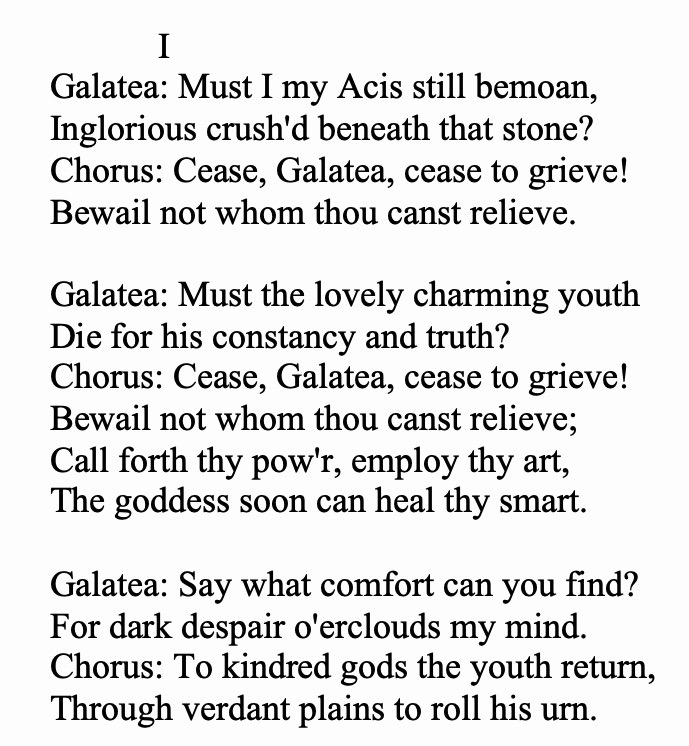
In part I, Galatea declares her grief in three couplets; when she repeats and melodically amplifies each complaint, the chorus answers in counterpoint against her, beginning with the comforting “Cease, Galatea, cease to grieve”, reminding her that she is a goddess and has the power to fix things.
This is transcendently beautiful.
The text:
(Concentrate on the music alone; you would have to be made of stone not to giggle at the image of the hunky Acis rolling his urn through verdant plains)
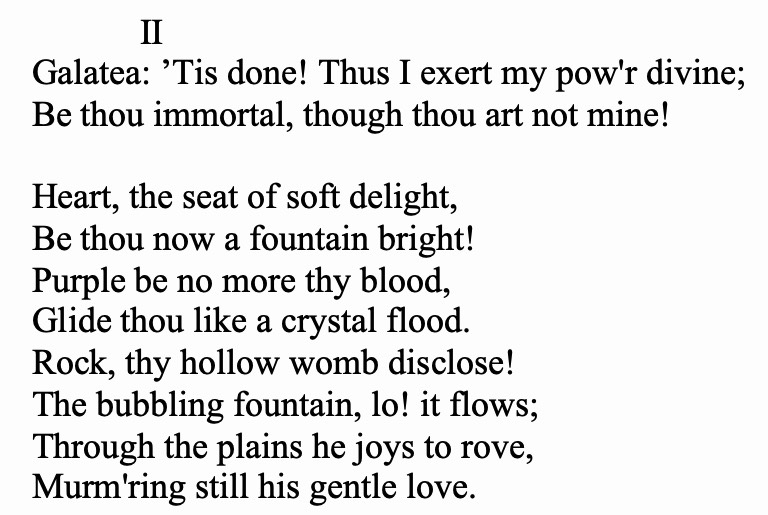
Part II is a larghetto aria in which Galatea commands that her dead lover’s body be transformed into a fountain (this can be hell to stage); since she’s a goddess, saying makes it so.
(It turns out that Acis is going to rove through the plains as a stream of water)
Part III is the choral finale, beginning with “Galatea, dry your tears”, and it’s splendidly contrapuntal, with an orchestra line running (like a flowing stream) against the choral line:
(“Shepherds’ pleasure, muses’ theme!” harks back to material from early in Act 1)
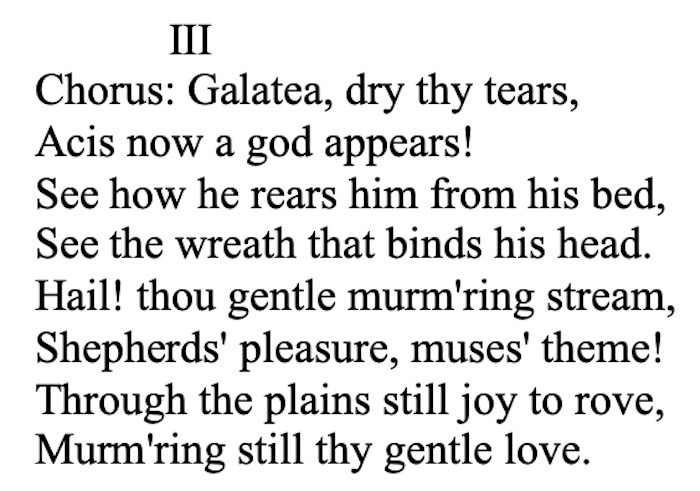
And it ends in a mere murmuring, a gentle pianissimo.
Leave a Reply