Two cockroaches, you have a couple of unpleasant bugs. Undulating masses of cockroaches streaming over all the surfaces in a room, you’ve got a shudder-provoking pest infestation. (I’ve had the latter experience with Argentine ants, and it was the stuff of nightmares for weeks.) But when does the former turn into the latter? This is the question asked by self-aware cockroaches in this cartoon by Lonnie Millsap in the 1/29/24 print-edition New Yorker:
(#1) Cucarachas conscientes de ellas mismas, addressing the puzzle in the sorites paradox / the paradox of the heap
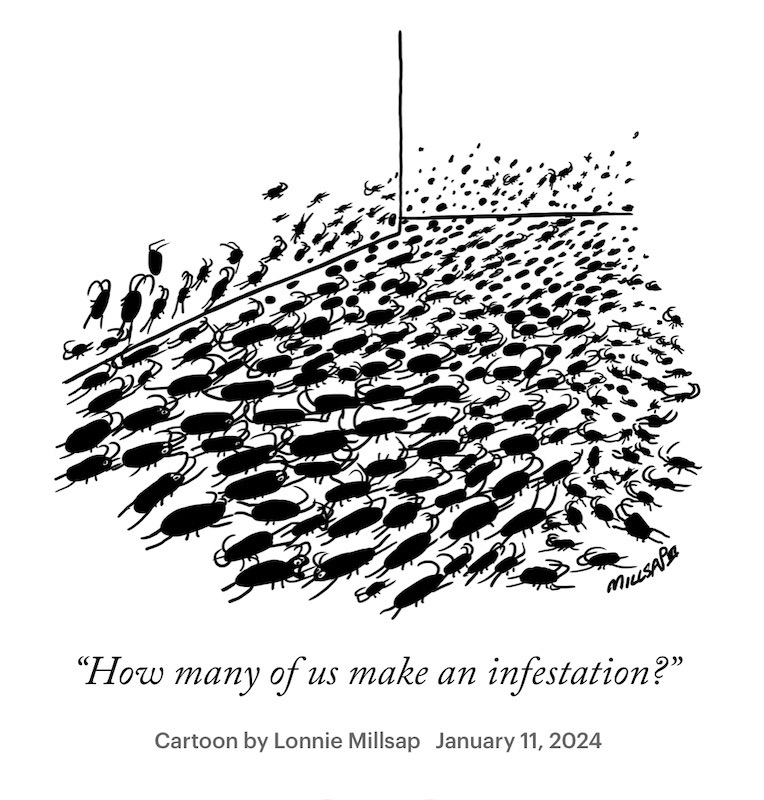
It takes a heap of vagueness to make a pair of cockroaches into a multitude. Previously on this blog:
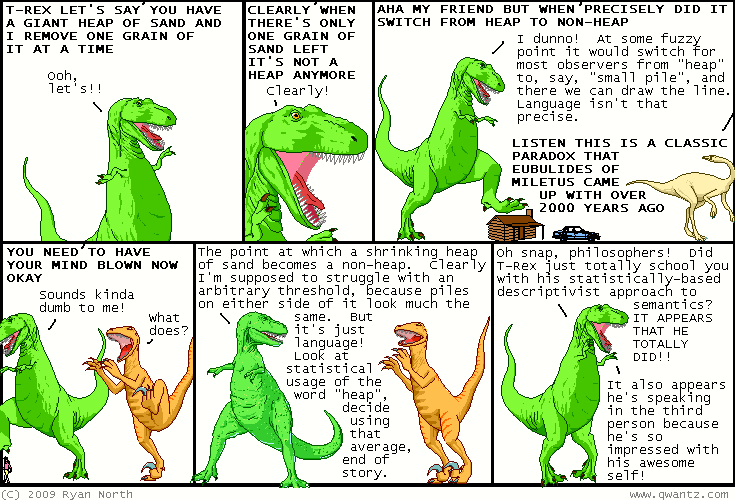
— in my 7/27/13 posting “Heaps of fun”, the Dinosaur Comics creatures on the Paradox of the Heap:
(#2) Notice: “at some fuzzy point” and “Language isn’t that precise”
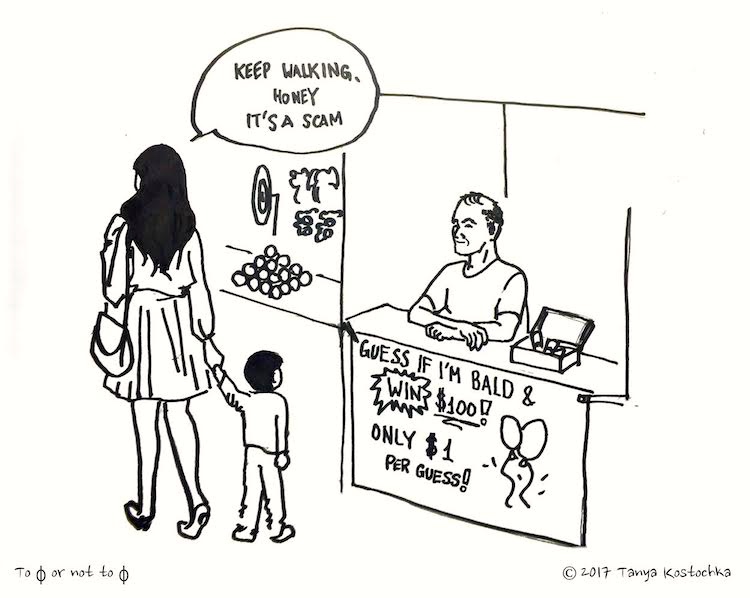
— in my 3/22/18 posting “The meaning of ‘is'”, about this Tanya Kostochka cartoon:
(#3)
Here you really have to know something about the philosophical tradition. From Wikipedia:
The sorites paradox (sometimes known as the paradox of the heap) is a paradox that arises from vague predicates. A typical formulation involves a heap of sand, from which grains are individually removed. Under the assumption that removing a single grain does not turn a heap into a non-heap, the paradox is to consider what happens when the process is repeated enough times: is a single remaining grain still a heap? If not, when did it change from a heap to a non-heap?
… This paradox can be reconstructed for a variety of predicates, for example, with “tall”, “rich”, “old”, “blue”, “bald”, and so on. Bertrand Russell argued that all of natural language, even logical connectives, is vague
[The cartoon] alludes to the variant with the predicate bald.
— from my 12/16/21 posting “A collective cry”:
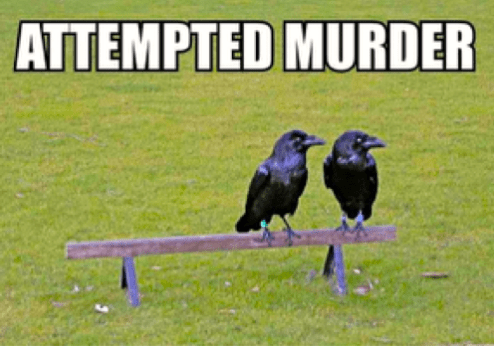
from my 5/12/14 posting “On the verge of a collective”, with a photoon raising the question of how many crows it takes to constitute a murder:
(#4) [caption:] This attempt at a murder, with only two crows, is clearly insufficient… Borderline cases: the paradox of the heap. Some collective nouns come with specific cardinalities for their referents: a quintet has 5 members, a minyan 10. Some collectives refer to large cardinalities: mob, swarm … Some refer to vague but small cardinalities: handful, smattering … Some refer to a range of cardinalities, but at the lower end of the scale, even down to 3 or 4: cabal, gang. But many, though specialized semantically in other ways, seem to be general collectives: flock and … terms of venery like murder. Their cardinalities can go very high: flocks of millions of birds — passenger pigeons, notably — have been reported. For these collective nouns, the question is how low they can go.
Suppose we have a group of 10 crows: clearly a flock, though a small one. At the other end, a pair of crows is not a flock. Now if remove one crow from the group of 10, we still have a flock, of 9 crows. If we keep removing crows, one by one, eventually we’ll get down to 2 — not a flock — and then 1 — not even a group (in the everyday use of group). When did things change from flock to not a flock?
This is a famous, and venerable, puzzle, which has turned up (at least) twice before on this blog.
The puzzle leads to a paradox only if we assume that words in everyday language are precisely defined — via necessary and sufficient conditions for picking out their referents, as they are in language specially constructed for technical — scientific, mathematical, medical, legal, etc. — purposes. Otherwise, vagueness abounds, in gray areas of applicability.
January 22, 2024 at 6:52 am |
A pronunciation note on the Greek-derived technical term sorites: /sǝrájtez/
January 22, 2024 at 7:03 am |
My husband and I have had, at times, somewhat non-serious arguments about the relative sizes of some, several, and a few.
January 22, 2024 at 7:11 am |
You guys and a fair number of semanticists too.