Encountered on Pinterest yesterday, a reproduction of this painting, identified there as a “Pompeian fresco” (and attributed to the painter Filippo Venuti) from the Palazzo Paradisio (a site I didn’t recognize, but it turns out to be a lavish palace on Malta). The central figure is clearly that of the winged Roman god Mercury, steering a small winged boat across the sea. (I don’t recognize the flag the boat is flying.) At the prow of the boat, a female figure, apparently in despair, languishes precariously.
This would presumably be Mercury in his role as the guide taking the souls of the newly dead to the underworld; as for the woman, if she’s meant to be some specific character from Roman mythology, I don’t recognize her. But the composition is all about Mercury.
(#1) And who would have thought Mercury was such a stud? — with the face of a handsome young modern Italian man, the body of a muscle-hunk, and just barely concealed genitals
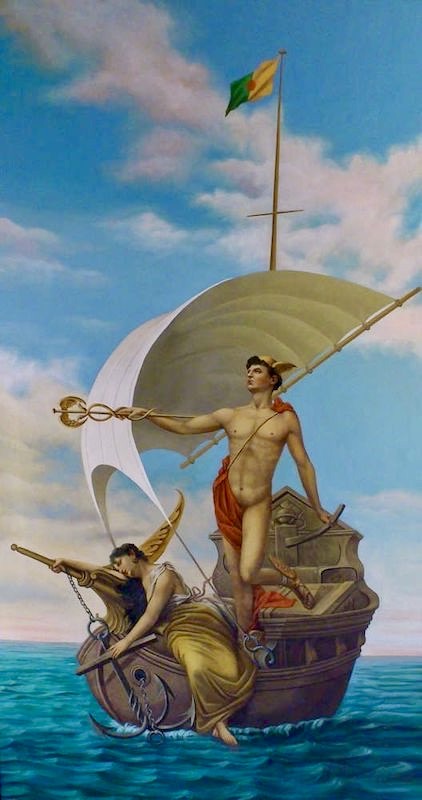
Ah, this is a modern work, painted in the first decade of the 20th century: a “Pompeian fresco” only in the sense that it’s in the style of the frescoes at Pompeii (near Naples; ancient Pompeii was destroyed in 79 CE by an eruption of Mt. Vesuvius, but the volcanic ash preserved an extraordinary record of both the art and the everyday life of the city). A modern work, painted about 2,000 years after Pompeii went under, on the island of Malta, about 345 miles by air from Naples.
The Palazzo Paradisio. From Wikipedia:
Palazzo Parisio, formerly known as Scicluna Palace, Palazzo Scicluna, and officially Palazzo Parisio and Gardens, is a 20th-century palace in Naxxar, Malta. On site was a hunting lodge built in 1733 by Paolo Parisio, and was used as a summer or permanent residence, barracks and a college, before being acquired by the Marquis [Giuseppe] Scicluna in 1898.
The marquis modified the building between 1900 and 1907 with the appearance visible today. Its architecture is composed of a Art Nouveau front and back façades and a Sicilian Baroque interior. Today, Palazzo Parisio and its surrounding gardens are in good condition and are open to the public.
… The Marquis approached Architect Annibale Lupi (born 1869) to design and built on site an Art Nouveau mansion. He commissioned a team of Italian architects, sculptors and painters, led by Carlo Sada (born 1855), to embellish the interior and garden with Sicilian Baroque architecture and Pompeiian art. Work began in 1900, and was largely complete by 1906, when the marquis and his family moved into the palace.
… The main ceilings’ frescoes were [done] by Giacomo Olzai and Filippo Fortunato Venuti, both from Rome.
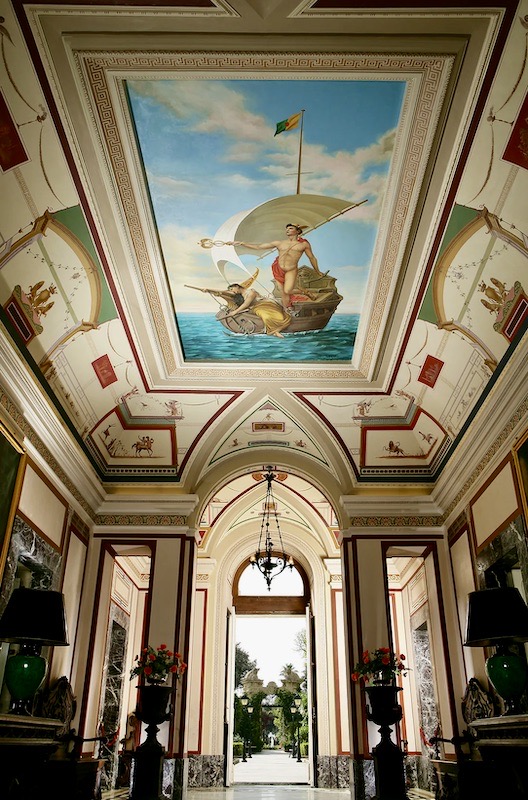
The whole place is a lavish festival of wow. Here’s the Mercury At Sea ceiling fresco in its actual setting, in the entrance hall to Palazzo Paradisio:
(#2) Annoyingly, there’s no critical or interpretive literature I’ve been able to find about the faux-Pompeian frescoes on Malta, probably because these works are seen as merely decorative and fanciful; but surely Olzai and Venuti had something in mind when they painted these very symbolically loaded frescoes (is Mercury At Sea really Last Ferry To Hades, or what?)
December 31, 2023 at 10:13 am |
For allusion hunters: The Maltese Falcon; Victory at Sea; Last Exit to Brooklyn. You could look them up.