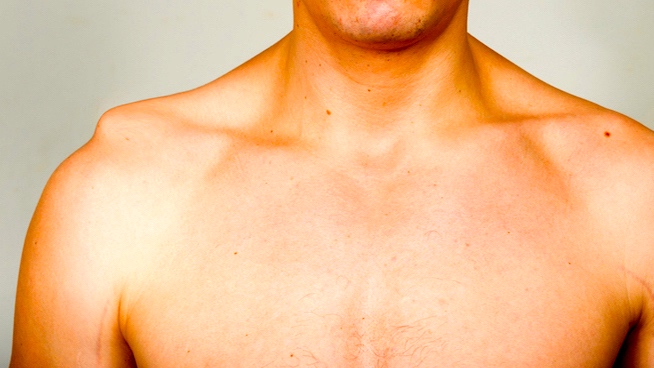
A few days back, an inquiry into a bodypart of personal interest to me: my 9/14/19 posting “Clavicular knobs”, in which these bony protuberances were illustrated on the body of a Scruff guy “Ricardo”. Ricardo’s photo cropped to focus on his shoulder handles:

(#1) Ricardo’s very visible clavicles, aka collar bones, terminating on either side in bony protrusions — an anatomical feature shared by my first male lover Danny and my husband-equivalent Jacques
I noted that clavicular knobs seemed to be very rare, even in lean-bodied men with very noticeable clavicles; and that Danny and I each believed we once knew a name for them but now we couldn’t recall it (or them).
First to arrive on Facebook with some nomenclatural clarity was Chuk Craig, who supplied the term acromion (Gk. ‘top of the shoulder’). Which led to the relevant joint, the AC, acromioclavicular, joint; to separated shoulders; and, in other directions, towards anatomical rarities (like protuberant acromia) and the psychology of perception and attention (if you’ve read my earlier posting, you’ve probaby been noticing clavicles a lot).
On the noun acromion, from OED3 (Dec. 2011) (in the context of Ricardo above, note the “robust, peg-like acromion” in the 1999 cite):
Etymology: < post-classical Latin acromion (1528 or earlier) and its etymon ancient Greek ἀκρώμιον (Hippocrates) < ἄκρο– acro– comb. form + ὦμος shoulder (see omo– comb. form) + -ιον, suffix forming nouns. Compare Middle French, French acromion (1534 in Rabelais).
Anatomy and Zoology. A bony process forming the lateral or distal end of the spine of the scapula, with which (in humans and certain other mammals) the clavicle articulates. Also attributive, esp. in acromion process. [1st cite in English 1578. Then:]
1653 T. Urquhart tr. F. Rabelais 1st Bk. Wks. xliii. 193 Then did the Monk with his staffe of the Crosse, give him such a sturdie thump and whirret betwixt his neck and shoulders, upon the Acromion bone, that he made him lose both sense and motion, and fall down stone dead at his horses feet.
1999 Nature 25 Mar. 328/2 This new taxon..has a robust, peg-like acromion and a low elevation on the spine that resembles the metacromion of Didelphis. [The noun metacromion in OED3 (Dec. 2011): Zoology. In some mammals: a process of the spine of the scapula [i.e. the shoulder blade] posterior to the acromion. [1st cite 1867]]
So Ricardo’s knobs are prominent or protuberant acromia, and we might say of them, “I admired his beautfully formed acromia”.
Etymological note: the acro– of acromion. From Michael Quinion’s affixes site on acr(o)- ‘a tip, height, or extremity’ [Greek akron, a tip or summit.]:
An acrobat (Greek bainein, to walk) is literally someone who walks on tiptoe; an acropolis (Greek polis, city) was a fortified part of an ancient Greek city, typically on a hill; an acronym (Greek onuma, name) is a word formed from the initial [‘top’] letters of a phrase.
In medicine, the acromion is the outward end of the spine of the shoulder blade. Medical conditions include acromegaly (Greek megas, great), abnormal growth of the extremities and face caused by excessive production of growth hormone, and acrophobia, extreme or irrational fear of heights.
[AZ: and in pidgin and creole studies in linguistics: acrolect vs. mesolect vs. basilect]
The rarity of Ricardo’s acromia. My search for images of prominent acromia — Ricardo’s acromia, as I will now call them, after Scruff-Man Ricardo as an archetype — was fruitless a couple of days ago, and a couple hours of searching through images of shrirtless / bare-chested men yesterday didn’t turn up any more. For a while I focused on images of athletes, especially football players (American football, rugby of all kinds, and soccer), for reasons that will become clear below. Eventually I realized that Ricardo’s acromia were unlikely to be visible in such men, because they would be concealed by the men’s massive shoulder musculature.
So I shifted my strategy to searching through shirtless twinks / teens etc. Tons of prominent clavicles amidst all the boysex, but none (that I found) with protuberant acromia.
If there’s a medical term for Ricardo’s acromia, I haven’t discovered it, despite searches on all sorts of possible descriptions and names, many of them floated in my discussion above.
In any case, I’ve been viewing it just as a rare variant (like the AB-negative blood type I mentioned in my previous posting), rather that as some sort of pathology. However, there’s a possibility that some instances of Ricardo’s acromia are the consequence of injury.
Shoulder separation. From Misty, a reader of this blog:
the cause of the clavicle knob could be minor shoulder separation, at the joint where the clavicle and shoulder blade (acromion) meet. That joint is the AC [acromioclavicular] joint. I suppose the bone grows in to fill the gap with repeated reinjury. Perhaps your lovers were football players.
Before I get into the anatomical and medical stuff, just a note to scotch the idea that Danny and Jacques were football players, or athletes in any sort of contact sport. As young men, they were not, I believe, nearly as profoundly unathletic as I was — but no, not jocks. And I’m pretty sure neither of them ever had a separated shoulder.
However, real people do get separated shoulders, and they can be tremendously painful, requiring serious medical attention. From the Stack site on the condition:
(#2) Ouch on the right shoulder
The shoulder is an incredible joint. It’s capable of extreme ranges of motion that allow you to throw a ball, swing a bat or push off against an opponent with extreme force. But it’s also one of the most vulnerable joints in the body. It’s a common targets for tackles and bodychecks, and it’s one of the first areas of the body that hits the ground during a fall.
This makes the joint susceptible to shoulder separations. In fact, 50 percent of shoulder injuries in contact sports are separated shoulders, which, depending on the severity of the injury, can keep an athlete out of action for up to 12 weeks.
(Note: A shoulder separation is distinct from (and generally more serious than) a shoulder dislocation, an injury in which the humerus, the upper arm bone, pops out of the cup-shaped socket that’s part of the shoulder blade.)
Perception and attention. Along the way, Dennis Lewis responded on Facebook to my posting about (visible) clavicles and their acromia:
I hadn’t noticed until the skeletal diagram. I’ve never noticed. And now I can’t help but noticing. 😲
Dennis and others. Dozens, maybe hundreds, of people will, at least for a while, be attentive to clavicles and their properties, now that I’ve shown them features distinguishing different types; the distinctions have become salient for them, and might even stick with them for a long time — slightly sharpening their perceptions of human bodyparts. (The effect is well known in psychological studies of attention and its effects on perception.)
My response to Dennis:
Alas, that is the way of such things. You can go through life happily not noticing that some people have attached (rather than free) earlobes — there seems to be continuous variation here, but attached earlobes are definitely the minority variant — until someone points out to you that there are two kinds of earlobes (you don’t even have to have names for the types), and then you can’t help noticing.
No one pointed out attached vs. free earlobes to me until I was a teenager. (As a free-lober, I’m in the majority. There must have been atached-lobers in my circle of acquaintances, but I just didn’t notice.)
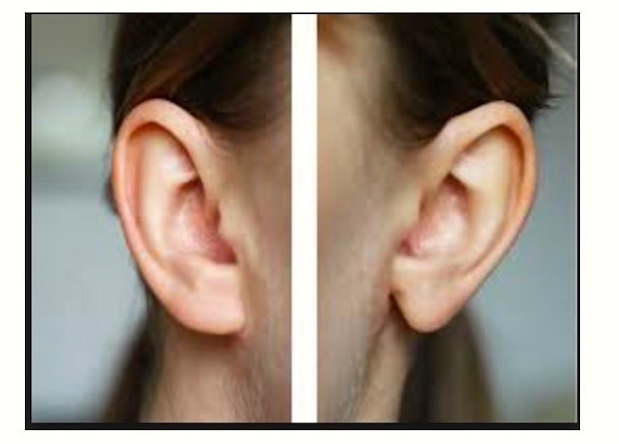
(#3) Attached on the left, free on the right
Not long thereafter, earlobes turned up in our biology textbook as an example of classic dominant vs. recessive Mendelian inheritance. This, as it turns out, was wishful thinking, though attached lobes are very much in the minority.
(I’m a solidly free-lobe guy, Ann Daingerfield (Zwicky) was as close to lobeless as you can get. Elizabeth Daingerfield Zwicky? She got one of each. Others have intermediately lobed ears. Genetics can be complicated.)
In any case, once I’d learned there was a distinction, I was inclined to notice it as a feature of human anatomy.
September 17, 2019 at 8:19 am |
Attached. I always knew I was special. Also, I have never had wisdom teeth. Does that make me more highly evolved? I’d like to think so.
September 17, 2019 at 3:30 pm |
Didn’t know about wisdom teeth, but it turns out that agenesis (failure to develop in a fetus) is pretty common, though probably a minority thing. But complicated: more common in females than males; more common for maxillary (top) third molars than for mandibular (bottom) ones — yes, you can have anywhere from 0 to 4 third molars (or extras!); wildly variable in different populations.
February 21, 2020 at 7:12 am |
I have protuberant acromia. Very noticeable and have had it since childhood. It used to be extremely noticeable when I was very skinny. I used to refuse to wear T-shirts after someone pointed out to me how weird it looked.
Lifting weights has alleviated the problem but it will take some serious muscle and bulk to hide them completely.
I wish I could have them shaved down.
May 29, 2023 at 8:18 pm |
Found your post after searching for more info on this topic. I have these shoulders too, as does my sister. I have very built shoulders too, no amount of mass will hide them. I also naturally have very strong shoulders and shoulder flexibility, so if there’s a genetic downside I’m unaware of it. I never even noticed my shoulders were different until my wife pointed it out and noticed them on my sister as well. I think they’re cool and unique. I wish more was known about them!
August 1, 2021 at 9:54 am |
I have them also never played any sports tpbeachbum@yahoo.com
November 7, 2021 at 7:00 pm |
It seems I have them too. Always thought it was because I was too skinny. One of my exes even said it was a problem for them.
May 16, 2023 at 2:11 pm |
Ugh that is horrible and upsets me. I’ve always been so self conscious of mine. Always got made fun of. Trying to lift and make it a bit less noticeable
January 5, 2022 at 5:05 pm |
Always self-conscious of mine. I lift weights to disguise them. I have always had them.
March 2, 2022 at 2:59 am |
I have them too and I am skinny already 🙁 I think I have seen very few people having them!
May 16, 2023 at 2:09 pm |
I have them very bad. Always have been extremely self conscious (I’m a male). Glad I found this article. I’ve always been in search of answers. I also have a barrel chest which I think contributed to the way my shoulders developed :/ you can reach out to my email
June 5, 2024 at 11:28 am |
My acromia are very prominent and can even be detected under clothing. I’ve had many comments made over the years and adding muscle hasn’t made any noticeable difference. I simply joke that it is where my wings were clipped, not everyone is born an angel.
September 25, 2024 at 8:55 am |
I’ve developed this over the years since I started resistance training and still unsure as to which exercises have caused it. It seems to be in my case because of the worn out / loosened ligaments attaching the clavicle to the scapula/acromion, so I tend to blame weighted push ups, but who knows. If it was just that, then I guess a lot of obsessive bench-pressers would suffer form this too. While painless so far, it feels really uncomfortable when this part of the shoulder pops/clunks during certain movements. My ortho told me that aside from surgery (in more extreme cases) or painkiller injections (when painful) there isn’t much to be done about this other than not overloading that joint. I don’t want to give up resistance training but also don’t want to cause myself further injury or wear out the ligaments further. This is possibly the only page I saw this condition properly pointed out, and my condition is not the AC joint separation or dislocation, it’s specifically this. If anyone on here has dealt with this feel free to write me. I don’t suppose there is a way of getting in touch with this Ricardo guy specifically to ask him about it, he might have some answers. Anyway, I think I’ll try some sports physio too, they might have something to say.
September 25, 2024 at 9:19 am |
It’s hard to believe there isn’t some discussion group somewhere on the net that’s devoted to protuberant acromia; certainly, the comments section on blog postings is ill-suited to the exchange of experiences and ideas. (I understand that this is the best you’ve been able to find.) Maybe you should start asking around on social media.
May 14, 2025 at 2:49 am |
Interesting. I have prominent acromion bones but I’ve never been self conscious of them because I have good broad shoulders in general. Mine look exactly like the guy in the main picture (unfortunately I’m not as good looking as him otherwise!). But my god if I put something on my should to lift like a piece of timber or metal it is seriously painful. I just have no padding there at all.
I never looked into this topic before but it does appear they are very rare. I dont know anyone else with them as prominent as me.