Today’s Bizarro, with a terrible pun (and a large number of Dan Piraro’s symbols):
 (#1)
(#1)
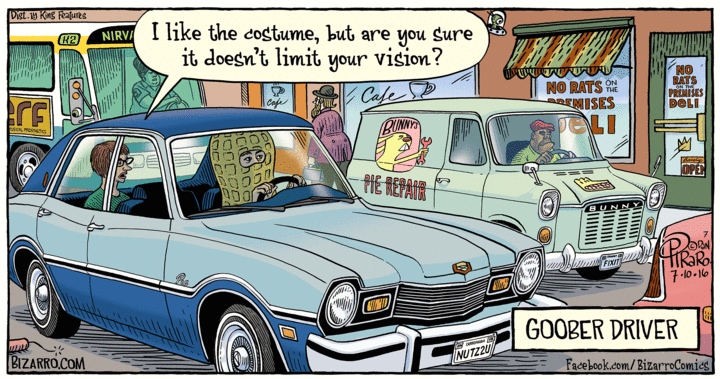
Start with the pun: goober driver ‘driver who’s a peanut’ (or, in a metaphorical extension, ‘driver who looks like, who’s dressed like, a peanut’), based on Uber driver ‘driver for Uber’. (If you don’t know about the Uber service, the only thing you’ll get in this cartoon is the ridiculousness of a someone in a peanut costume driving a car.)
Then the symbols. Dan Piraro says there are 7 of his symbols in this strip; for an explanation of them, see this Page.
On to goober, the lexical item at the center of the cartoon. From NOAD2, which marks it Amer. informal:
1 (also goober pea) a peanut. [OED first cite 1833 from KY; 1834 from GA]
2 often offensive a person from the southeastern US, especially Georgia or Arkansas. [a metonymic extension of sense 1]
– offensive an unsophisticated person; a yokel.
OED2 gives no etymology for the word, but most other sources trace it to an African origin, probably from a Bantu lanhuage, though which one is unclear. (It wouldn’t have to originate in a single language, of course.)
The ‘unsophisticated person, yokel’ sense is, of course, not necessarily offensive; like hillbilly, it should probably be labeled “often derogatory”– because it refers to a social group that is often disparaged, not, I think, because the label itself is offensive. So we get American tv comedies like The Beverly Hillbillies, which treated the Clampetts as figures of fun, but with affection; a title like The Compton Niggers or The West Hollywood Faggots would never fly on mainstream tv, no matter how affectionate a view such programs might take of their subjects. (Yes, these titles would also miss the phrasal overlap of The Beverly Hillbillies, but in the context that’s a minor issue.)
Which brings me to the heartwarming American tv comedies set in rural North Carolina, starring Andy Griffith and featuring, among others, the character Goober Pyle. From Wikipedia:
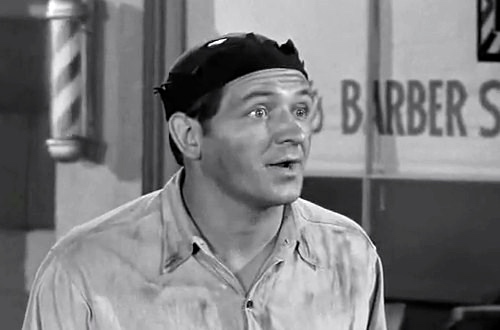
Goober Pyle is a fictional character in the American TV sitcom The Andy Griffith Show and its later sequel series Mayberry RFD. He was played by George Lindsey. Lindsey initially read for the part of Gomer Pyle, Goober’s cousin, which eventually went to singer Jim Nabors. The two actors had similar backgrounds; Lindsey was originally from Jasper, Alabama, while Nabors was originally from Sylacauga, Alabama.
 (#2)
(#2)
July 10, 2016 at 8:30 am |
a title like The Compton Niggers or The West Hollywood Faggots would never fly on mainstream tv, no matter how affectionate a view …
True, although “Queer Eye for the Straight Guy” might be considered a borderline case.
July 10, 2016 at 9:30 am |
Not really borderline, I think. By the time “Queer Eye” came along, universities had Queer Studies programs, and queer was widely used as an identifier for individuals, television shows, movies, music, and more.
November 28, 2025 at 4:46 am |
It’s not goober pile it was Gomer Pyle. A goober is a peanut. It’s not offensive. I’m from the south and have used that word all my life to describe peanuts. I grew up in front of a peanut field. Sometimes when you’re acting silly will call you a goober because you’re being goofy. It’s not offensive. People have made it offensive maybe but it’s not meant to be offensive. It’s actually a Bantu word from Africa meaning peanut. Literally it’s a peanut. So if someone calls you a peanut it means they think you’re cute and sweet. If they call you a goober it means you’re being cute silly peanut. Lighten up folks. Don’t be a goober. Here have peanut.
November 28, 2025 at 5:39 am |
I’ve allowed this comment, which I would normally just have deleted, because there’s a larger point about what makes an expression offensive or insulting. Which has absolutely nothing to do with the etymology or literal meaning of the expression, but everything to do with how (some) people use the expression: to give offense. After all, the current ultimate offense in American English, the N-word, is straightforwardly derived from the Latin word for ‘black’. Meanwhile, we have the Black is Beautiful movement.
The etymology of goober is irrelevant, as is its literal meaning ‘peanut’ and the use of peanut as an endearment, in a world in which goober is also used as a slur.
I have been verbally attacked as a pansy and a fruit, but the existence of the innocent literal senses of those words doesn’t wipe away the intended sting. And I remind you that bitch just means ‘female dog’, who could object to that?
November 28, 2025 at 10:13 am
From 1939*, Joan Crawford as Crystal in [i]The Women[/i]: “There’s a name for you ladies, but it isn’t used in high society… outside of a kennel. So long, ladies!”
From the same time, Auntie Em in The Wizard of Oz: “Almira Gulch, . . . [f]or 23 years, I’ve been dying to tell you what I thought of you, and now… well, being a Christian woman, I can’t say it!” Of course it’s not clear what epithet she had in mind, but the same one would fit.
*And earlier; I don’t know the date of the play or if this quote was in it, but I’ll bet it was.
November 28, 2025 at 12:58 pm |
“It’s not goober pile it was Gomer Pyle.” Read the fucking posting, honey; Goober and Gomer Pyle are two separate Mayberry characters, cousins.
November 28, 2025 at 12:53 pm |
To JBL: nice cites. Meanwhile, derogatory bitch is attested back to Old English; according to the OED, it became “increasingly taboo from the 18th century onwards”.