In two parts. First, an appreciation of a piece of intellectual history written by Geoff Pullum:
Geoffrey K. Pullum, The prehistory of generative grammar and Chomsky’s debt to Emil Post, Historiographia Linguistica, October 2025
And then a puzzle about the source of the central idea in my very first academic publication (appearing in an extraordinarily obscure place):
Arnold M. Zwicky, Grammars of number theory: some examples, Working Paper W-6671, MITRE Corporation (Bedford MA), 20 November 1963 (available on-line here) — hereafter, GmNuTh
Pullum, October 2025. The abstract:
Generative linguistics has a longer prehistory than most linguists realize. The rewriting systems that Chomsky brought into linguistics as generative grammars were explicitly defined more than a century ago, as part of a project to formalize inference rules in logic, and were later applied to studying mathematical properties of certain kinds of infinite sets. Their developer was the mathematician and logician Emil Leon Post, whose work was inspired by Clarence Irving Lewis and Cassius Jackson Keyser. Post also proved the first two theorems about what linguists now call generative capacity. The idea of deploying Post’s systems within linguistics was first suggested in 1950 by the logician Paul Rosenbloom. I review the relevant pre-1950 work, and explore the reasons for its having remained so little known among linguists.
A remarkable piece of intellectual history, tracing both the ideas and the lives of the people involved (the principals, Post and Chomsky, but others as well), based on a huge range of library research and an enormous number of interviews and consultations with living sources (including me).
And then the finale:
Perhaps the most surprising point of all about the 20th-century linguistics literature is that there are no citations of Post’s key papers even in works on mathematical linguistics. Searching Hockett (1966), Wall (1972), Kimball (1973), Levelt (1974, 2008), Partee (1978), or Partee et al. (1993) yields not a single citation of a paper by Post.
… My conclusion is that it is just not credible that Chomsky attempted to suppress reference to two key mathematical papers that he knew about, concealing their significance so he could claim more credit for himself. His multiple mentions of Post’s name over the years (§ 5.2) would have to be explained as Freudian slips. The truth is that Chomsky was the only 20th-century linguist who ever even attempted to draw any attention to Post’s work. Others — even those with strong mathematical or historical interests — seem to have had no knowledge of the relevant papers. Yet Chomsky was not really in a position to tutor them, since (as he has plainly said) his own knowledge of Post’s work appears to have been limited to vague recollections of textbook accounts.
The point where Chomsky really gives insufficient credit relates to the two remarkable passages from Rosenbloom [Paul Rosenbloom, Elements of Mathematical Logic (1950)] quoted earlier. The charitable view about this is that although they influenced his very early thinking (back circa 1950 when he was an MA student at Penn), Chomsky did not explicitly remember them. He later acknowledges Post’s place in the computability theory pantheon and credits Post with the term ‘generate’, but he nowhere mentions that Rosenbloom was the one who first saw that such systems might find an application in linguistics.
Chomsky’s work in formal linguistics, rich in original syntactic observations as it is, might well be seen as a 70-year project aimed at vindicating Rosenbloom’s suggestions, and that calls for some atonement. But it seems to me very likely that the solution to the puzzle of why he never cited [Post’s papers] Reductions or Unsolvability is simply that he never read them.
… Concluding remarks. Whether the sins of bibliographical omission discussed in this paper are judged mortal or venial, they should not be allowed to obscure certain genuine conceptual continuities. Historians of linguistic science should recognize the debt that all of generative linguistics owes to Post. Rewriting systems — i.e., generative grammars — did not emerge simply from Noam Chomsky’s original ruminations in the early 1950s, nor out of the descriptive methods defined by his mentor, Zellig Harris. Emil Post had carefully defined them more than a century ago, before Chomsky was born, and proved two generative capacity theorems about them while Chomsky was in high school.
The detailed exposition in Paul Rosenbloom’s 1950 logic textbook contained an explicit suggestion that rewriting systems might find an application within linguistics. Chomsky definitely knew Rosenbloom’s book, but never acknowledged its remarks on this topic. Whatever his reasons, the lack of recognition and citation for Post’s technical papers of 1943 (Reductions) and 1947 (Unsolvability), and Rosenbloom’s explication and promotion of them, needs to be remedied in future histories of linguistics.
Zwicky, November 1963. Beginning with criticism from GKP in his piece (with some of the central ideas boldfaced):
Far from having tried to keep Post’s name out of the picture, Chomsky appears to be literally the only linguist in the entire 20th century who ever cited Post at all. Even in Arnold Zwicky’s mathematical study of how rewriting systems can capture number-theoretic predicates (Zwicky 1963) there is no mention of Post, which is truly surprising, since Zwicky’s project is so closely related to what Post (1944) was doing: studying the mathematical properties of sets of positive integers through the character of rewriting systems that generate them, representing integers in unary notation and so on). The general ideas Post had raised seem to have been under discussion in the 1960s at and around MIT, but apparently linguists had no acquaintance with his most crucially relevant papers.
(I certainly didn’t. Post was a part of the history of mathematics, but all I had was textbook summaries of the field. In fact, mathematicians, engineers, and scientists rarely study the histories of their fields; mostly they base their work on compendia of the current state of knowledge.)
I wrote GmNuTh 63 years ago — a very long time ago for recovering detailed memories of your work — in the summer of 1963, as a participant in a large language and computation project at MITRE, at the end of my first year of graduate school in linguistics at MIT. It was my first academic publication of any kind, though far from my first writing for publication; as a reporter — a floater — for the Reading Eagle newspaper (in Reading PA) from 1959 through 1961, I wrote many published articles, some with bylines (which my father especially treasured), but all my clippings vanished (along with all copies of my Princeton senior thesis, on mathematical linguistics) in my many moves around the country. Your past is constantly disappearing.
The abstract for GmNuTh:
(#1) Not as informative as Pullum’s characterization
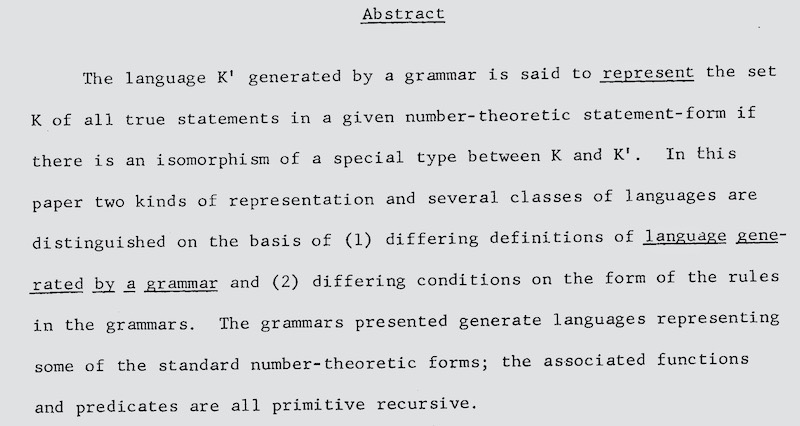
But where did I get my ideas? The references for GmNuTh are not particularly helpful:
(#2) All references on the generative power of various types of formal systems
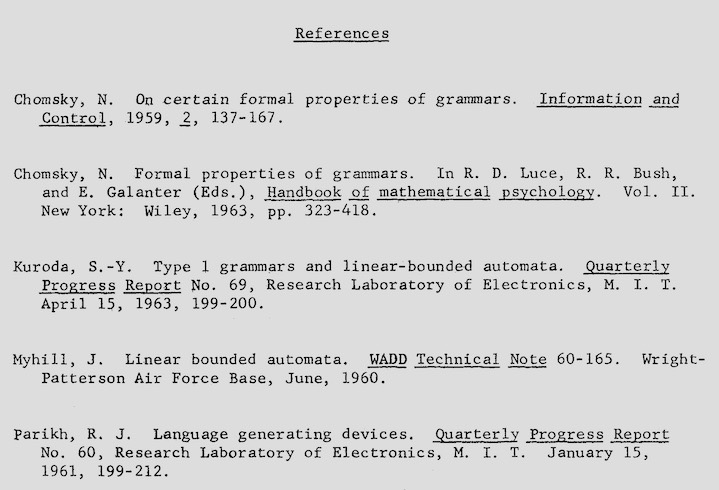
Some candidate sources. More relevant is the reading from my undergraduate math courses, especially:
Paul Rosenbloom, Elements of Mathematical Logic (1950)
Stephen Kleene, Introduction to Metamathematics (1952)
Martin Davis, Computabuility and Unsolvability (1958)
And then the gold is probably to be found in this note of acknowledgment in GmNuTh, saying that I was
indebted to Joyce Friedman for her suggestions
Joyce and I shared an office for a while, and worked together on MITRE projects through 1965. About her, from Wikipedia:
Joyce Barbara Friedman (1928 – November 28, 2018) was an American mathematician, operations researcher, computer scientist, and computational linguist who worked as a professor at the University of Michigan and Boston University and served as president of the Association for Computational Linguistics.
But now you see the problem. Though she might have had some recollection of the advice she gave me (and might well have been aware of Post’s work), JBF died 8 years ago (at the age of 90), long before GKP could have interviewed her. My own memory is a blank on the relevant matters; it vanished — unsurprisingly, I think — years ago. The possibility that I could find a crucial pointer in Rosenbloom (or, even less likely, Kleene or Davis) is slight; but my copies of these books went away in the dispersal of my professional library some time ago, and I no longer have library access, so I’m unlikely to be able to consult them in the hope of finding a clue.
I know, know. I’m nothing but a disappointment. (Here a nasty voice says: you’re not trying hard enough; and, anyway, you’re doing it wrong.) And I haven’t worked in mathematical linguistics for decades; it’s an abandoned area of expertise: ex-expertise. (What I end up saying to people is that, yes, someone with my name did write that stuff, did that work that you admire, in 1963 or 1970 or 1985; he had such promise. But that guy is dead, and now all you’ve got is me.)
I’ve put off responding to GKP’s critique for several months now, because I found the topic profoundly depressing. But recently I’ve been in wonderful high spirits and good health, so I thought I could manage it. Evidently I was wrong.
April 17, 2026 at 6:23 am |
Glad to see evidence of the good spirits and health!
I was a grad student in linguistics at MIT in 1963-1964 and 1965-1968. [In 1964-65 I was studying in Novi Sad in Yugoslavia.] But even before then, beginning about 1961, I was coming over from Harvard and auditing courses at MIT. I remember hearing the term “Post production systems” at some point while at MIT, and I gathered that Post had used rewriting notation (“this goes to that”) before Chomsky, but I didn’t know what theorems Post had proved about these systems. I think I did know that Post was only interested in what Pullum calls stringsets, whereas “we” (early generative grammarians) used rewriting notation to provide not only terminal strings but tree structures for them, which was of additional interest for linguistics.
I certainly never heard of Rosenbloom and his book. Is Pullum suggesting that each of Chomsky’s papers should cite previous works that gave Chomsky initial inspiration to start working along the lines that he did? If Pullum is, then it means that I too should cite Roman Jakobson, “Russian Conjugation”, _Word_ 4 (1948), and Milka Ivić, _Pravci u lingvistici_ [‘Trends in linguistics’], 1963 and later editions, in every single article that I write.
Something went wrong with Pullum’s footnote: “19. Two almost-exceptions to my claims here have been suggested to me, but they really only
underline my point. Bart Karstens pointed out some eccentric remarks about variability, meaning, and creativity in Jakobson (1969: 659) [words missing?] quotes four stray phrases (out of context and out
of sequence) from some diary fragments in Post (1941[1965]), the rejected autobiographical
essay.” But I do want to say that it’s not surprising that Jakobson mentioned Post in addition to lots of other predecessors. Jakobson enjoyed citing currents of thought from many different fields of endeavor: the sciences, literature, theater, music, arts, and suggesting shared features and mutual influences between all of them.
April 17, 2026 at 7:25 am |
I wouldn’t say that Jakobson’s mentioning Post’s work was merely ornamental, but it certainly wasn’t a piece of analysis — just one of his broad strokes “citing currents of thought from many different fields of endeavor”, as you put it .
I do know that Joyce Friedman arranged an appointment with RJ at some point, but I don’t know what they talked about; I recall wondering what they might have in common. But Post’s work would be a possibility.
(Ann Daingerfield Zwicky — like JBF, not a student in any of RJ’s courses, though I was) also arranged an appointment with RJ, about poetics; I sat in on that appointment.)