A follow-up to my 3/16 posting “The breakfast walk”, in which I looked at a few of the businesses and offices on the walk
from 722 Ramona St., between Forest and Homer (my house) to 566 Emerson St., at the northwest corner at Hamilton (the Palo Alto Creamery, a standard place for Saturday breakfast with my daughter Elizabeth in the old days), along a route fixed in its details
with a promise that I’d do a separate botanical posting, about some of the flowers and trees along the way. Necessarily much more selective — there are many hundreds of plant species in those two and a half blocks — and sensitive to date as well as location (customarily, my first example blooms and my last example fruits around now, in the Ides of March / St. Patrick’s Day period); and so it is this year)
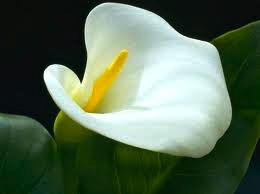
— 1 a few houses up Ramona St. from mine (and all over Palo Alto), ordinary white callas. From my 3/17/12 posting “St. Patrick”
the calla lilies are in bloom, just a few houses from mine. I allude, of course, to Katharine Hepburn as Terry Randall in Stage Door (1937), delivering these memorable lines on stage:
The calla lilies are in bloom again. Such a strange flower — suitable to any occasion. I carried them on my wedding day, and now I place them here in memory of something that has died.
In a photo:
(#1)
… The spathe [of Zantedeschia aethiopica] is the part that looks like a conical petal, but is in fact a bract; think of the petal-like bracts of pointsettia or dogwood flowers. The spadix is the central part that looks like a stamen, but is in fact a spike of very small yellow flowers.
The showy trumpet-like whiteness of Z. aethiopica makes it a suitable Easter flower, an alternative to the standard Easter lily.
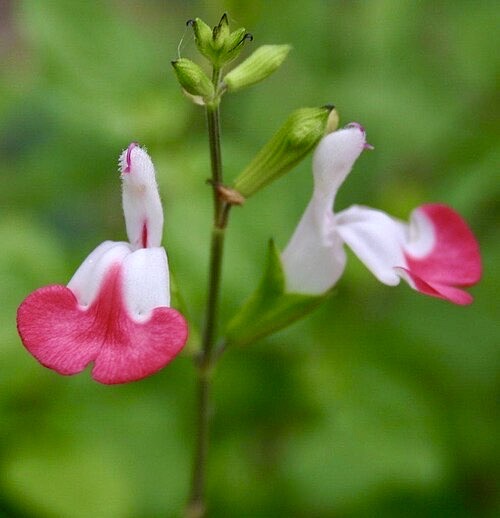
— 2 right outside the side door of the Skin Spirit spa (701 Emerson, at Forest), on the south side of Forest Ave. just past my condo complex, a huge stand of Salvia microphylla (small-leaved sage) ‘Hot Lips’ that has just come into bloom, as here:
(#2)
From my 9/17/09 posting “Hot Lips”:
Noted in front of 325 Forest Ave. in Palo Alto, a small hedge of … ‘Hot Lips’ in bloom — covered in small labiate flowers, some bicolor, some all red, some all white
…Small-leaved (hence the species name microphylla), intensely scented, fashioned into a hedge. A pleasant plant, which it turns out was created by hybridization fairly recently.
[with excursions on the adjective hot and other uses of Hot Lips]
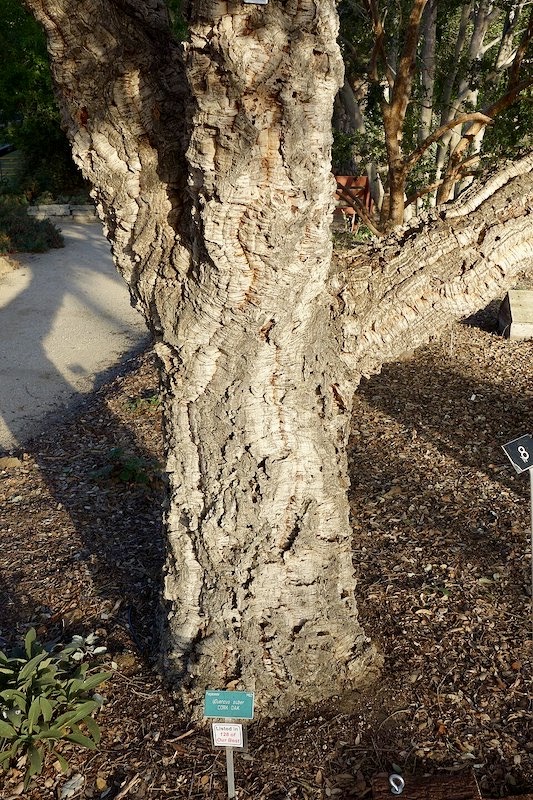
— 3 on Forest where “Hot Lips” flourishes, in the strip between sidewalk and street, a young tree with gnarled bark, a cork oak. From Wikipedia:
(#3) Cork oak trunk (unharvested) (photo from Wikipedia)Quercus suber, commonly called the cork oak, is a medium-sized, evergreen oak tree … It is the primary source of cork for wine bottle stoppers and other uses, such as cork flooring and as the cores of cricket balls. It is native to southwest Europe and northwest Africa [but often grown in California]. In the Mediterranean basin the tree is an ancient species with fossil remnants dating back to the Tertiary period. It can survive for as long as two centuries. Typically, once it reaches 25 years old, its thick bark can be harvested for cork every 9 to 12 years without causing harm to the tree.
It endures drought and makes little demand on the soil quality and is regarded as a defence against desertification. Cork oak woodlands are home to a multitude of animal and plant species.
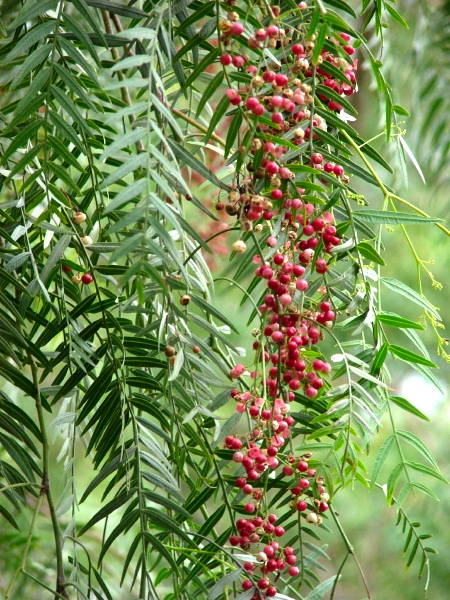
— 4 further west along the south side of Forest, at the corner with Emerson St., what we know locally as a California peppertree / pepper tree, not yet in bloom, much less producing berries. From my 12/14/14 posting “California peppertree” (note the date):
More or less out of my back door, there’s a California peppertree that I noticed yesterday because the heavy rains had knocked so many of the peppercorns down on to the sidewalk. A photo:
(#4)
A pretty (and evergreen) tree, with aromatic [and edible] berries; I delight visitors to California by picking some berries and crushing them between my fingers to release the scent.
The tree is Schinus molle. Schinus is a genus of flowering trees and tall shrubs in the sumac family, Anacardiaceae.
The tree is native to an area from the Peruvian Andes to southern Brazil and is generally referred to as the Peruvian peppertree; it is now common in California.
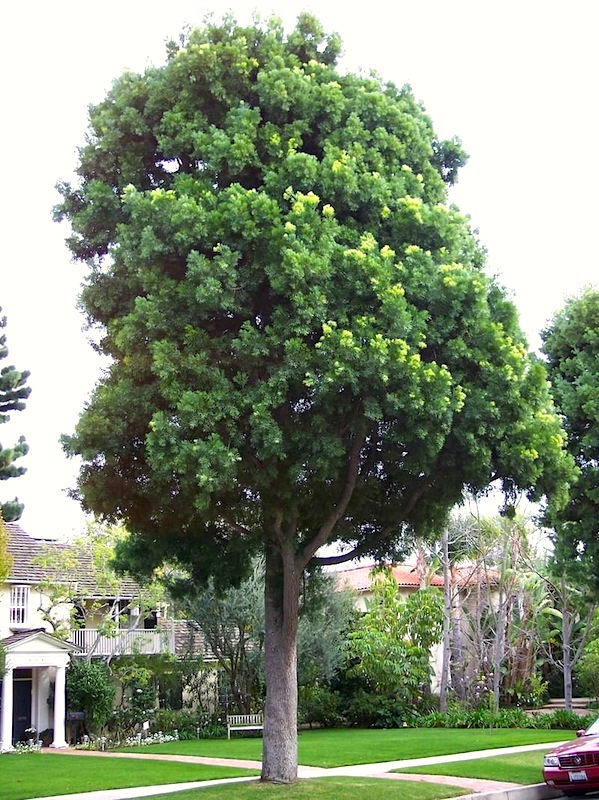
— 5 outside 640 Emerson (in the west side of the street), once the Gordon Biersch brewery and restaurant, now the Meyhouse Turkish restaurant, a huge Podocarpus gracilior tree that actually arches over the street. From my 3/15/13 posting “podocarpus”:
The street tree outside the Gordon Biersch restaurant in Palo Alto is the sturdy and reliable Podocarpus (or Afrocarpus) gracilior or “fern pine” (though it’s not a pine and is only fancifully similar to ferns).
(#5)
It is native to eastern Africa.
… The mature seed is purple, and is dispersed by birds and monkeys which eat the fleshy coating.
… It’s a sturdy and handsome street tree, requiring relatively little pruning; it provides good shade, and is largely self-limiting in height. It does drop the seeds prolifically… ; GB has to sweep them up daily in season. I would have thought that squirrels would love them, but I’ve never seen a squirrel eating one or carrying it off (and the neighborhood is rich in squirrels, though extremely poor in monkeys).
My helper Isaac and I went out in mid-morning today, before the temperature soared to 90F., and ended up looking at dozens of plants (a large number of which I couldn’t identify) carefully arranged around the Skin Spirit building. That is, without even getting around my block. We do a lot of marveling.
March 18, 2026 at 1:34 pm |
Not to spoil the mood, but some hot lips would do me right…
March 18, 2026 at 1:48 pm |
May the spirit of Margaret Houlihan descend upon you.