The phenomenon, from Wikipedia:
The Dunning–Kruger effect is a cognitive bias that describes the systematic tendency of people with low ability in a specific area to give overly positive assessments of this ability. The term may also describe the tendency of high performers to underestimate their skills. It was first described by the psychologists David Dunning and Justin Kruger in 1999. In popular culture, the Dunning–Kruger effect is sometimes misunderstood as claiming that people with low intelligence are generally overconfident, instead of describing the specific overconfidence of people unskilled at particular areas.
As then in my mail recently, as a benefit of my being a member of the American Academy: “Why Do Fools Think They Are Wise? Should the Wise Believe Themselves to Be the Fool?” (a conversation between new American Academy member David Dunning and Academy President Laurie L. Patton about the Dunning-Kruger effect), Bulletin of the American Academy of Arts & Sciences Winter 2026, pp. 44-57.
From this conversation:
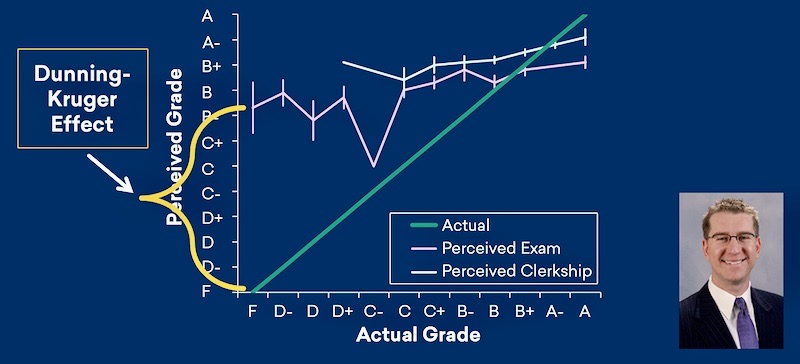
[Dunnng:] In our research, we’ve looked at particular areas of skill in which you can have expertise, illustrated, for example, by medical students in an OB/GYN rotation or clerkship. At the University of Florida in Jacksonville and at Shands Hospital in Gainesville, 1,100 third-year residents were asked after they finished their final exam, “How well did you do on the exam? And how well did you do on the clerkship?” Figure 1 shows their actual grade on the exam and on the clerkship compared to their perceived grade.
FIGURE 1: MEDICAL RESIDENTS IN OBSTETRICS/GYNECOLOGY CLERKSHIP
[caption:] K. Edwards, et al., “Medical Student Self-Assessment of Performance on an Obstetrics and Gynecology Clerkship,” American Journal of Obstetrics and Gynecology188 (4) (2003): 1078–1082What we see is that the top people underestimate themselves a little bit, while the people at the bottom are getting F’s and D’s on the exam, but they think they’re getting a B or a B minus. On the clerkship itself, they think they’re getting a B plus when they’re actually at the bottom of their class. Those who don’t know don’t seem to know that they don’t know, and they don’t have the expertise that they thought they had. There’s a gap at the bottom.
That gap has come to be known as the Dunning-Kruger effect. By the way, the photo in the figure is of Justin Kruger, a professor at New York University [AZ: and Dunning’s collaborator]. The problem that we described is that ignorance is not only infinite; it is often invisible. You just don’t know that you don’t know. [AZ’s bold-facing for emphasis] The way I would describe it is that those who lack expertise lack the expertise that is necessary to realize just how much expertise they lack. This has been demonstrated in a number of areas and with different groups of people, such as with poker and bridge players, debate teams, computer programmers, surgical trainees, public health emergency responders, the general public’s ability to tell fake news from real news, health literacy, financial literacy, aviation students, gun owners, and even wine tasters. Those who don’t know don’t know that they don’t know. And we can actually go further than that. We should not expect them to know, and [that] if they knew, they would work harder to correct their lack of knowledge.
I note that Dunning doesn’t take the easy way out of just mocking the D-K afflicted as foolish and invincibly ignorant, but (humanely and generously) understands their situation as an inevitable consequence of their lack of the relevant experience: we should not expect them to know.
And then in discussion, Patton offers this remarkable (meta-)comment to Dunning:
In doing some work on your work, I found that the Dunning-Kruger effect is itself subject to the Dunning-Kruger effect. In fact, there’s a website in which people think they know what the Dunning-Kruger effect is. What has it been like to live with that and to carry that for twenty-five years?
Dunning is baffled:
I truly don’t understand why this thing has stayed viral for twenty-five years.
But constructive:
I don’t want to dismiss confidence or even overconfidence, because confidence is not something to avoid. Confidence is something to manage. There are times when you want to be confident …
March 3, 2026 at 4:11 pm |
Thanks for this one, Arnold. It’s quite helpful, especially the part about why we shouldn’t expect the non-experts to recognize their lack of expertise. But then there’s what happens when you find yourself in a setting where you’re confronted with the performance of people whose knowledge/skill is much greater than yours: a piano recital, a tournament, an advanced class…Who are the people who don’t recognize that their heads have been handed to them when the scores posted? Do Dunning and Kruger deal with that question?
March 4, 2026 at 7:17 am |
The American Academy discussion gets into the issue of expertise vs. experience, and also into the many ways in which D-K has been misunderstood. If I understand the net connections correctly, it seems that the full AmAcad discussion, involving quite a few participants, is easily available to the general public, not just AmAcad members / fellows, so you can see for yourself what’s been said and don’t have to depend on my paraphrasing things for you.
(Since its founding in 1780, the American Academy has been intended as a public good, so it makes sense that its deliberations and programs should be freely and easily available to the general public.)
March 4, 2026 at 12:07 pm |
I’ll check that out, thanks again.