Yes, about wishes for the new year of 2025. I am absurdly behind on my postings.
Setting for the new year: the whole weight of our past sorrows and fears for the future. From my 3/7/24 posting “A dirge murmured round the grave”:
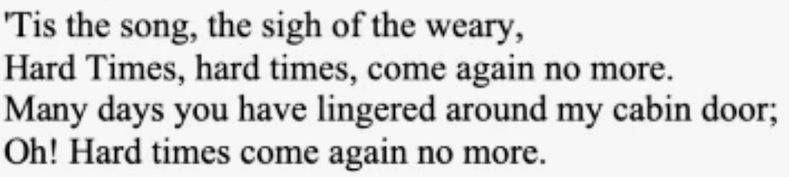
From my 9/2/19 posting “More dream linguistics”, about Stephen Foster’s “Hard Times, Come Around No More”, with a chorus that laments the hard times of the past and pleads that they not return:
… Foster’s South was a sentimental fabrication, a piece of imaginative fiction, peopled by stage folk: dreamy elegant whites and simple but oppressed blacks. Yet the song could be folded into other, different, narratives of terrible pasts and uncertain futures. It could, for instance, be sung by blacks, for blacks … Eventually, by singers of the caliber of Mavis Staples, in a version (from the album Beautiful Dreamer (2004)) informed by the black experience but illustrated by images of the Great Depression, with both white and black subjects
… It can be worked into a lament for the hardness of life in the Southern mountains, combined with passionate affection for the place, as in the Anonymous Four + [Bruce] Molsky version [on the album 1865: Songs of Hope and Home from the American Civil War (2015) — 1865 marking the end of the Civil War] …, or in the astonishing re-imagining of the song in a live performance by a trio of Yo-Yo Ma, Marc O’Connor, and Edgar Meyer, with James Taylor on vocals (on the album Appalachian Journey (2000))
… Or it can carry the whole weight of our past sorrows and fears for the future, displayed (apparently) without reference to any particular history, as in a heart-breaking live [Transatlantic Sessions] performance by Kate & Anna McGarrigle and friends (Rufus Wainwright, Emmylou Harris, Mary Black, Karen Matheson, and Rod Paterson)
… the haunting chorus:
My hope is that upon my death there will be no grave, mournful or otherwise, for dirges to be murmured over, but that my ashes will go into the soil to feed growing plants. Transflormation would be delightful — I think I’d make a fine flowering shrub — but Ovidian metamorphoses are hard to come by these days, so I’ll settle for nourishing a garden.
For the new year. On 12/30/24 I wrote to my friend, and frequent visitor on this blog, Gadi Niram (whose birthday is 2/26/70, so he’s 30 years younger than me):
Your assignments for the coming year: DON’T DIE. DON’T GIVE UP AN INCH OF YOUR JAUNTY SPIRIT. These directives are not negotiable.
GN’s response:
I refuse to die while I still have so many plans for my future. Writing my space opera (opera as in soap opera) novel, perhaps my long-considered return to graduate study, travel, language learning. Lots of good stuff. Friendship. Food. Art and music. There will be no dying on my part for quite some time. I of course hope the same is true for you.
I’m touched that you find my spirit jaunty. And I think it is, despite the best efforts of mental illness to dull it. Turns out that modern medicines and psychotherapeutic techniques, along with my good fortune in being able to apply my intellect to the development of insight into my various illnesses and their effects on me, well, it’s all pretty powerful stuff. I shall continue to jaunt and defy my challenges and limitations.
Coming from a friend whose jauntiness I consider an inspiration, I must say that I was deeply touched to know that you think of me in this way. Despite your struggles and challenges and sorrows, you remain one of the great sources of joy, delight, wit, inspiration, information, and so much more in my life and so many others. I think that DON’T GIVE UP AN INCH should be the [somewhat inadvertent Star Trek reference incoming] prime directive for you and me and our colleagues in the Jaunty Spirit Club®. We kinda owe it to ourselves and the world we seek to brighten.
From each according to his ability, to each according to his needs (German: Jeder nach seinen Fähigkeiten, jedem nach seinen Bedürfnissen) is a slogan popularised by Karl Marx in his 1875 Critique of the Gotha Programme. The principle refers to free access to and distribution of goods, capital and services.
Here I understand FETE as two linked moral principles, rather than as a claim about economic systems: a call to use your abilities (both gifts of nature and acquired abilities) and accrued advantages, to use these to (in GN’s words) brighten the world around you, to help out, to work to meet the needs of others. This understanding came to me in childhood, as a moral gift from my father: things to bear in mind in finding your way in life. No more than advice to do the best you can (we are all imperfect), but, still, advice to do good.
Brighten the Corner. GN’s formulation — seeking to brighten the world — twanged a hymn I learned in church camp some 75 or so years ago: “Brighten the Corner Where You Are” (by Ina D. Ogdon and Charles H. Gabriel, 1913):
[verse 1]
Do not wait until some deed of greatness you may do
Do not wait to shed your light afar
To the many duties ever near you now be true
Brighten the corner where you are[chorus]
Brighten the corner where you are
Brighten the corner where you are
Someone far from harbor you may guide across the bar
Brighten the corner where you are
From Wikipedia about a notable recording of this hymn:
Brighten the Corner is a 1967 studio album by the American jazz singer Ella Fitzgerald, her debut album on Capitol Records.
… The album was Ella’s first since leaving the Verve label, which had seen her produce her most acclaimed body of work. It marked a sharp change of direction for Fitzgerald, as Brighten the Corner saw Ella sing Christian hymns, reflecting her own spirituality, and eschewing the Great American Songbook standards on which she had previously concentrated.
“Brighten the Corner” is track 4 on side 1. You can listen to Ella’s version here.
And then a remarkable footnote. From Wikipedia:
Homer Alvan Rodeheaver (October 4, 1880 – December 18, 1955) was an American evangelist, music director, music publisher, composer of gospel songs, and pioneer in the recording of sacred music.
… Rodeheaver appeared on at least eighteen record labels and five hundred sides during his recording career. His most recorded piece was [Billy] Sunday’s theme song “Brighten The Corner Where You Are,” which Rodeheaver recorded for at least 17 different labels.
Leave a Reply