Today is both Opal Armstrong Zwicky’s college graduation day — 🎓 that’s a mortarboard — and also Kentucky Derby day — 🏇🏼 that’s a jockey on horseback. It also seems to be Rain Day, in both Pittsburgh and Louisville. In any case, two occasions packed with sentiment for me.
(Opal’s graduation from Pitt is straightforward on the sentiment front, but the Derby might need some explanation: Ann Walcutt Daingerfield (later Zwicky) was born — to a celebrated family of owners, breeders, and trainers of thoroughbreds — on Derby Day in 1937, and her father, Keene Daingerfield, ended his working life as the senior state steward for thoroughbred racing in the commonwealth of Kentucky, serving as a judge overseeing racing at both Keeneland in Lexington and Churchill Downs in Louisville. Note: Ann died in 1985, Keene in 1993.)
I hope to post separately about today’s Derby and about my odd long-ago life in the elite social world of central Kentucky and in the complex culture of thoroughbred racing. But today I bring you something completely different, an especially fine Bizarro cartoon, one that comes with a sting.
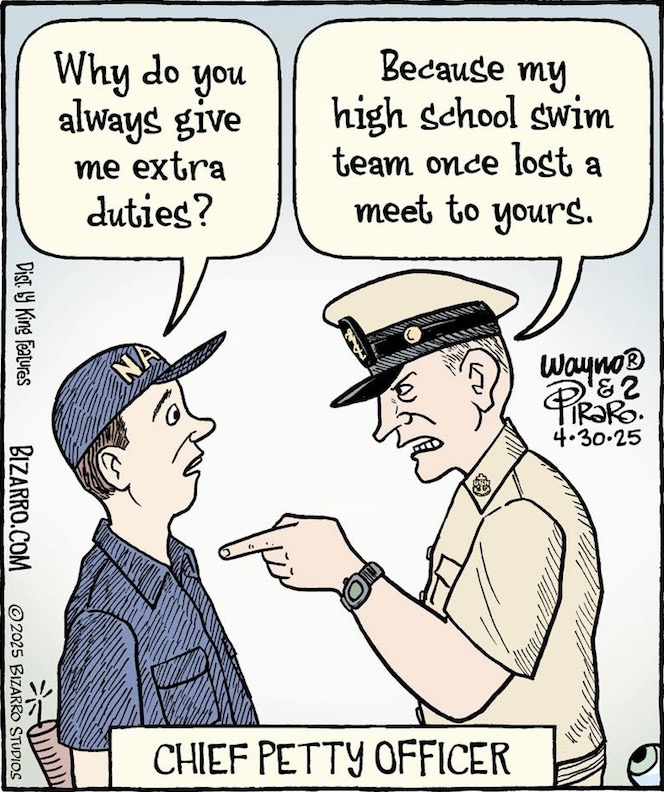
The 4/30 Bizarro “Chief Petty Officer” (to which Wayno gave the alternative title “Pulling Rank”):
After years, the thin-skinned injustice collector extracts his revenge (if you’re puzzled by the odd symbols in the cartoon — Wayno says there are only 2 in this strip, and they’re easy to find — see this Page)
My comment on Facebook when Wayno posted this cartoon:
— And this is, who would’ve thought it, a political cartoon. A pointed one.
The officer, preposterously, unloads on his subordinate as revenge for a long-past event unconnected to either of them personally. Who acts like that? Your first reaction is to laugh because it all seems so extravagantly exaggerated. And it is.
But in real life there are in fact people so insecure that they feel wounded by the tiniest slight, carry the memory of these slights with them over long periods of time, brooding on them, and then seek to punish anyone in any way associated with them. This is seriously disordered behavior, scary stuff, taking what’s known as injustice (or grievance) collection into dangerous sociopathy.
The person who currently proposes to rule America from a golden imperial throne is just such a sociopath (and that’s the political edge to the Bizarro cartoon). Known as a thin-skinned bully from childhood on (with a reputation for beating up on younger kids but running home in a fit of rage if opposed) and collecting and cultivating grievances throughout their life, they are now attempting to extract revenge on everyone they believe to have crossed them.
Their bundle of pathologies is, unfortunately, very much bigger than these two — thin-skinned bullying and injustice collecting — but the whole alarming picture is not my point today. I’m content to pursue these two, and to move away from a focus on this one person. First, thin-skinned bullies as a cultural trope. Then, more somberly, injustice collection gone awry, even to revenge extracted by mass murder.
The thin-skinned bully. Easing into things with a lexical note, from Merriam-Webster on-line:
noun thin skin: a tendency to get easily upset or offended by the things other people say or do. | He has such a thin skin that he can’t even take a little good-natured teasing [hence the adj. thin-skinned]
On to the thin-skinned bully as a cultural trope. From the tv tropes site: “Thin-Skinned Bully”, with a ton of cross-references to other tropes:
See that big hulking brute in the playground? The one constantly stealing your lunch money, giving routine poundings, and making everyone in his presence absolutely terrified of him? Well, that kid half his size flicked him on the nose, and he ran away like a punk.
Bullies are cowards. They pick on those weaker than them. However, in media, this tends to be set to such a level that Dirty Coward doesn’t even cut it. Fictional bullies are the undisputed kings of Glass Cannons, being buff and blustering, but reduced to screaming infants begging for mercy the moment their prey even remotely implies they’re Not Afraid Of Them Anymore and stand the slightest chance of fighting back. The local school bully will run screaming for mommy the instant his victim fights back. The ruthless Domestic Abuser will be left neutralized with a single Groin Attack. The Big Bad that Kicks The Dog is a mere Harmless Villain.
This trope can be misleading, particularly if it encourages children to believe that challenging bullies carries no risk. While it’s Truth in Television that bullies are generally acting out of some kind of insecurity, many are sufficiently accustomed to violence that it doesn’t scare them. It can’t be assumed that all bullies, or even most, would be frightened off by fighting back.
Sub-trope of Paper Tiger, a character who isn’t as tough as their physical appearance and/or personality suggests. Compare Miles Gloriosus, a character who puts on a brave act but is usually an incompetent coward in the face of real danger. Might overlap with Easily Embarrassed Youngster. Often the result of someone Challenging the Bully, and it can overlap with Swiper, No Swiping! if being told not to bully is what makes them resign.
The injustice / grievance collector. From Mary Ellen O Toole, “The Dangerous Injustice Collector: Behaviors of Someone Who Never Forgets, Never Forgives, Never Lets Go, and Strikes Back!”, Violence and Gender 1.3 (2014):
The term “injustice collector” is one I have used for nearly 20 years. In The School Shooter: A Threat Assessment Perspective, I defined an injustice collector as someone who “nurses resentment over real or perceived injustices and no matter how much time has passed the Injustice Collector will never forget or forgive those wrongs or the people he or she believes are responsible” (O’Toole 2000). In the FBI’s original research on cases of mass murder in schools, my colleagues and I reviewed every aspect of these cases and found that many of the shooters manifested a pattern of behavior that was quite interesting and likely contributed, in part, to a revenge-based motive for the shootings. This behavior pattern involved accumulating real or imagined slights, insults, or putdowns over a period of time, often beginning from when these shooters were young children. As they continued to collect more and more injustices, they also began developing a world view and a life philosophy that included themes of being discriminated against, victimized, mistreated, bullied, and disrespected. Revenge fantasies [then] appeared to be an appropriate and logical response for them (O’Toole 2000).
Leave a Reply