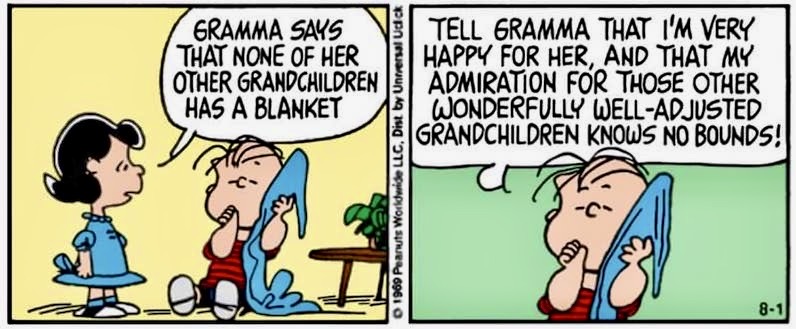
Another brief posting opening up a parallel, from the world of grammar, style, and usage, to yesterday’s posting “Accepting variation, or not”, about the (attempted) enforcement of normative prescriptions for other sorts of behavior. The two crucial panels of a Peanuts comic strip from yesterday’s posting:
(#1) Lucy relays to Linus their grandmother’s disapproval of his security blanket; Linus defies her admirably with a sarcastic defense of variation in behaviorGramma’s disapproval is implicitly two-pronged. Prong 1 is that having a security blanket is, variously:
different, atypical, unusual, ill-adjusted, nonconforming
while Prong 2, unspoken, is that it is also
undesirable, reprehensible, even contemptible, potentially threatening
Gramma refuses to accept the behavioral variation that Linus displays, thus mirroring the lack of social acceptance of other kinds of variation — in particular, the disapproval, by many, of same-sex desires, practices, and identities; and the more specific disapproval of what I’ve called f-gay men — the effeminate and the faggy. Disapprovals that are especially wounding because Prong 2 is wrapped up in them.
Now to something that might at first glance might seem to be completely different, but also involves a judgment of disapproval — nonacceptance — on a different sort of failure to conform to normative prescriptions, coupled with what amounts to a companion moral judgment on the whole business, including the people involved in it.
A lightning glance at ORW. There’s a Page on this blog with links to my postings on the normative prescription on language that I’ve called One Right Way, which insists that there is only one correct expression to convey a given meaning. (Yes, in this form it’s a grotesque idea, but there it is, wielded against many specific usages and, of course, the people who use them.) From the introductory material on this Page:
More generally, ORW embodies the instinct to object to variation in itself, and to insist [not only that there is only one correct expression to convey a given meaning, but also that] only one spelling, only one punctuation, only one pronunciation, only one of alternative inflectional forms, indeed only one meaning (per word) should be counted as correct.
At root, the passion that ORW arouses in some people seems to spring from a profound distaste for variation / variability in all things, arising from the idea that the world would be better if we all behaved the same way all the time (and, perhaps, from a fear of the other). This strikes me as an idea very much against nature (where variability of all sorts flourishes) and also deeply inhumane. But now we are in deep waters; for the moment I’ll just side with Linus on language use as well as on practices like using a security blanket.
Leave a Reply