🐅 🐅 🐅 three tigers for ultimate May, slavering to devour the steamy rabbits of June; but first, a drama of citations
It started on 5/27, in my posting “Extremely famous in a very small world”, where my rheumatologist reported that he had come across me cited, in Kory Stamper’s Word by Word: The Secret Life of Dictionaries (2017), as an an authority on linguistics (for my writing about the recency illusion).
To which Mike Pope, a technical writer and editor currently at Google, responded on Facebook with a comparison to his 2022 book Crash Blossoms, Eggcorns, Mondegreens & Mountweazels: 101 Terms About Language That You Didn’t Know You Needed.
The beginning of our dialogue:
— MP > AZ: Heh. I cite you 17 times in my book, based on a simple count of how many times “Zwicky” appears in it
— AZ > MP: Ah, but what are the chances that my rheumatologist will read your book?
— MP > AZ: Sadly, they are low. But I can send him a copy!
— AZ > MP: That’s a very entertaining idea.
And so it has been arranged. Amazon is sending a copy to Dr. David John Fischer at the Palo Alto Medical Foundation.
Here I point out that I have cited — well, mentioned — MP, wow, over 70 times on my blog. But I have, unaccountably, failed to post about his book, an oversight I will now remedy.
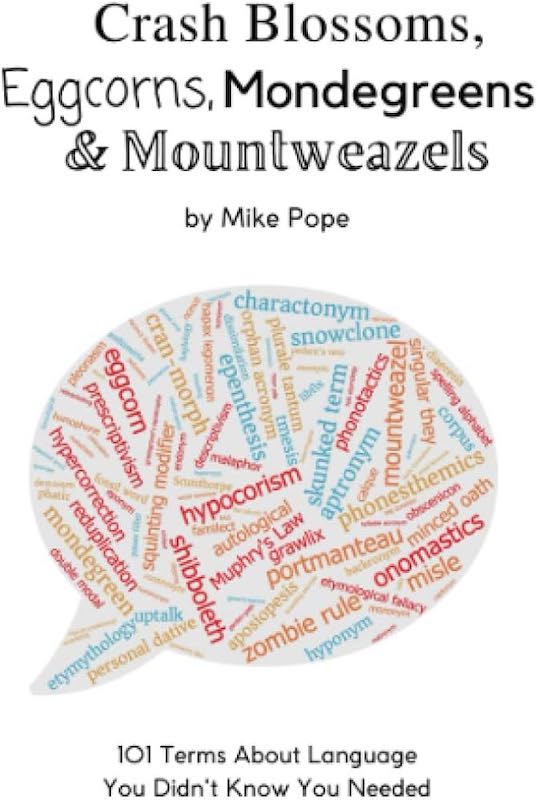
Crash Blossoms, the book. The cover and MP’s blurb:
You might have heard someone say “for all intensive purposes” instead of “for all intents and purposes.” Did you know there’s a name for this type of mistake (eggcorn)? Or that there’s a name for the #@$%*! characters that cartoonists use for swearing (grawlix), for how -gate has become an all-purpose way to label a scandal (libfix), and for words like K-9 made of numbers (numeronyms)?
We notice language and talk about it all the time, but we don’t always have the words for how to talk about it. This book provides an entertaining, light-hearted review of terms about everyday language.The terms range from the serious — vocabulary used by professional linguists — to the fanciful and just plain funny. Each entry is a story, many of which readers will recognize from their own experience, whether it’s misheard song lyrics (mondegreens) or how and why people sometimes use redundant terms like “free gift” (pleonasm).
Anyone who’s interested in language (and who isn’t?) will find something to love in this book, and everyone who’s read it will consider what they hear and read with deeper knowledge and greater curiosity.
Leave a Reply