I begin the story in medias res, with a May 27th Facebook comment by Probal Dasgupta on a posting of mine:
— PB > AZ: Speaking of the way one pronounces the acronym “AZ”, I’ve been puzzled by the fact that some function words that end in orthographic s in English (as, is, has) use a /z/ while others (us, this) use an /s/. I’ve failed to find a specialist who is generous with their time to tell me the diachronic sequence that led to this … My puzzlement originated in the fact that a friend of mine, in her Indian English, says “us” with a final /z/, definitely not in keeping with what most speakers of Indian English do.
With the help of Elizabeth Closs Traugott — nether of us experts in the phonological history of English or the development of spelling conventions, neither of us able to find an authoritative text or an actual living expert, but both willing to take a shot at some possibly useful speculation — I gave PB some tentative responses. And then came the news from his family that he had died, suddenly and unexpectedly, during the night of June 1st, at the age of 72.
His query to me was characteristic — intellectually curious and open, thoughtful and specific — and showed that he continued to follow my work closely, which is how we came to be (geographically distant) friends: when I was in an unhappy moment of doubt about the value of my research and writing, he sent me a bracing message of appreciation, with specific details, so that I came to think, jokingly, that at least I had a guy in Kolkata.
From this story, you will see his striking humanity, but nothing in that story predicts his passionate political engagement or his steady competence at academic administration.
There will be a ceremony of remembrance on the 12th:
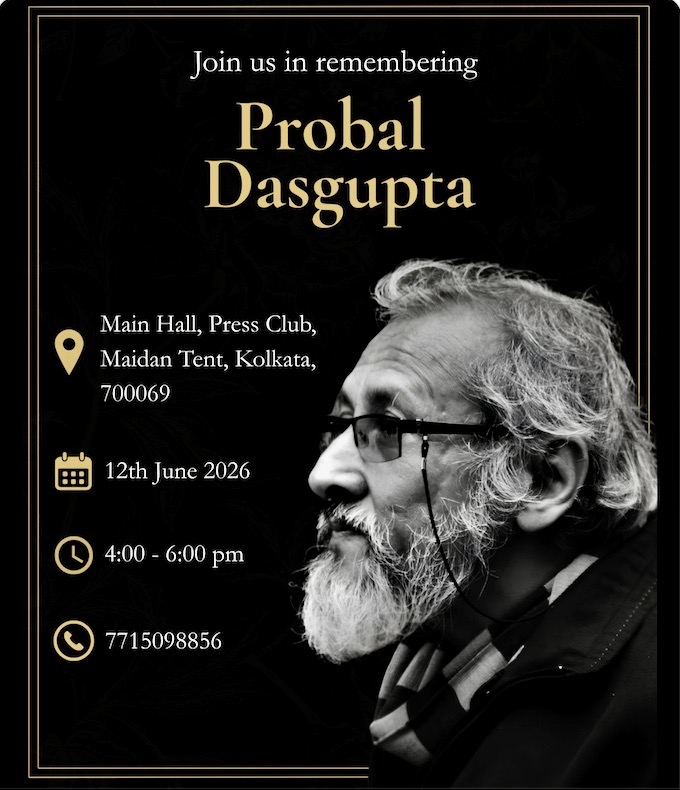
From Wikipedia:
Probal Dasgupta (19 September 1953 – 1 June 2026 [in Kolkata, West Bengal]) was an Indian linguist, Esperantist and academic administrator. He published his first article [about phonology] in Indian Linguistics, the journal of the Linguistic Society of India, at the age of eighteen.
… In 1957 he travelled to Ithaca, New York, where his father was pursuing doctoral studies at Cornell University. He attended East Hill High School during this period. The family returned to India in 1961.
After returning to India, Dasgupta attended St. Lawrence High School in Kolkata, where he was placed in the Bangla-medium stream. He later studied at St. Xavier’s Collegiate School, completing his schooling in 1970.
Dasgupta studied linguistics with Pali as a subsidiary at Sanskrit College, Kolkata. He subsequently pursued higher studies in linguistics at Deccan College Postgraduate and Research Institute, Pune. In 1975 he joined New York University’s Graduate School of Arts and Science, where he completed his PhD in 1980. His doctoral dissertation, Questions and Relative and Complement Clauses in a Bangla Grammar, was supervised by Lewis Levine and Ray C. Dougherty.
In collaboration with Rajendra Singh [Professor of Linguistics at Montréal], Dasgupta contributed to the development of the substantivist approach to linguistics, an orientation that incorporates elements of Whole Word Morphology into a broader theoretical framework.
… In 1993 he published The Otherness of English: India’s Auntie Tongue Syndrome, a sociolinguistic study examining the status of English in India
… Beyond linguistics, Dasgupta wrote on Esperanto studies and language policy.
A good life for a good man, but ended too soon.
June 8, 2026 at 4:10 am |
Probal Dasgupta raises an interesting question that I have also puzzled over, but I have never tried to find an answer. I add a small data point. Some British speakers also pronounce ‘us’ with final /z/, and my example is Brian Cox, the physicist and TV presenter.
June 8, 2026 at 4:26 am |
Yes. In my correspondence with PB (and ECT) I noted that us with final /z/ was a known feature of northern British dialects. But I don’t know the details of when and where and for what social groups.