Stay strong, and stay the course.
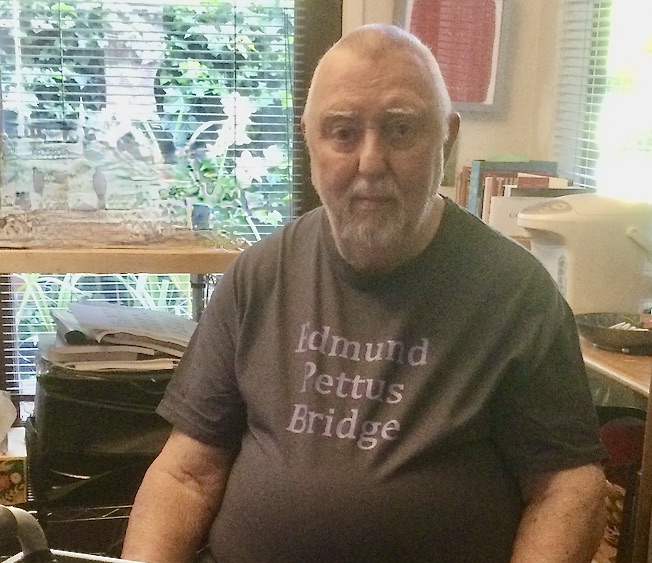
In today’s mail came my Stand Up and Stand Out t-shirt for racial justice. Deliberately designed (by me) with an understated message — Edmund Pettus Bridge — in serious muted colors and an elegant font, not in the neon colors and tough sans serif fonts of my in-your-face queer t-shirts (today’s is just a rainbow QUEER shirt, but yesterday’s was a neon pink BIG FAG, and an equally obtrusive FAGGOT is up for tomorrow):
The professor in his home lair, sun streaming in from the garden outside (photo by my caregiver J, who today had to endure my recollections of †Haj Ross from 1963 on and many more stories from my life, plus my impassioned summary of the history of American racial (in)justice from the Emancipation Proclamation through this week)
What the bridge says. From my 4/15/22 posting “LET US NOW PRAISE FAMOUS BLACK WOMEN:
A hero of mine … from back in the disastrous days of the 1960s, when we got to regularly view scenes of literally murderous rage by white people directed at black people (every so often those hate-deranged whites actually did murder black folks, or lynch them; John Lewis escaped with his life, but just barely). But I’m getting ahead of my story. Some very bald facts, from Wikipedia:
[On 3/7/65], Lewis led the first of three Selma to Montgomery marches across the Edmund Pettus Bridge. In an incident which became known as Bloody Sunday, state troopers and police attacked the marchers, including Lewis.
… Heroically dedicated to the cause of civil rights, physically heroic in that enterprise, and then an able and effective legislator, representing not just black Atlanta, but essentially all of it equally.
What the fact-filled Wikipedia account fails to capture is he was an irrationally decent man (decent way beyond rational expectation), full of irrational hope (hopeful way beyond rational expectation) — buoyed by his faith, true, but there his decency and hope were, and some of it was quite astonishing, because it was in fact far from conventional Christianity. What I said on Facebook:
he truly believed that we could reach the Promised Land in this life (not in an afterlife on Jordan’s other bank) — just not in his life, it would take some time.
Conventional Christianity tells us that life on this earth is filled with pain, terror, mistreatment, outright slavery, and wickedness, but that the believer will be rewarded with undiluted and enduring joy and delight after death, with Jesus in the life everlasting. I’m sure John Lewis believed that too. But he also thought that with resolution and determination and good will you can change this world, make it truly better. You can remake this world in the spirit of Christ’s love. But the project will take some time and we have to stay the course.
Stay the course, and stay strong. That’s what the bridge says.
Leave a Reply