🎁 🎁 🎁 three presents for 1/5, the 12th day of Christmas, Epiphany Eve (I am Melchior, King of Persia, an old graybeard bearing gold), as I struggle with the afflictions of my body (plus some extras, like ten days of near-deafness) and with a long litany of Things Gone Wrong, including the roof rats that have been eating away a wooden door on my patio (it’s winter, and they got cold and hungry, and seem to have imagined that things would be better inside my storage closet) and a prescription drug service whose erratic and incomprehensibly shifting software has consumed significant chunks of four of my days as I tried to get some prescriptions refilled on-line for mail delivery — I tell you this to explain that my absence from posting has been neither thoughtless indolence (stretched out on a plushy sofa while snacking on chocolate truffles) nor yet another near-death episode (with ambulances, emergency rooms, and surgeries), but just the confluence of a high level of everyday medical awfulness and the howling devils of daily life (les choses sont contre nous, et les bêtes aussi)
So let’s talk about axolotls. This from an elfshelfism that came my way back in December on Facebook, which I failed to save, but then it turns out to have surfaced in a posting on Threads on 12/13 — these things get passed around from hand to hand, like jokes and nursery rhymes — by charlesrathmann, who wrote
Elf on a shelf. eh? I give you:
(#1)
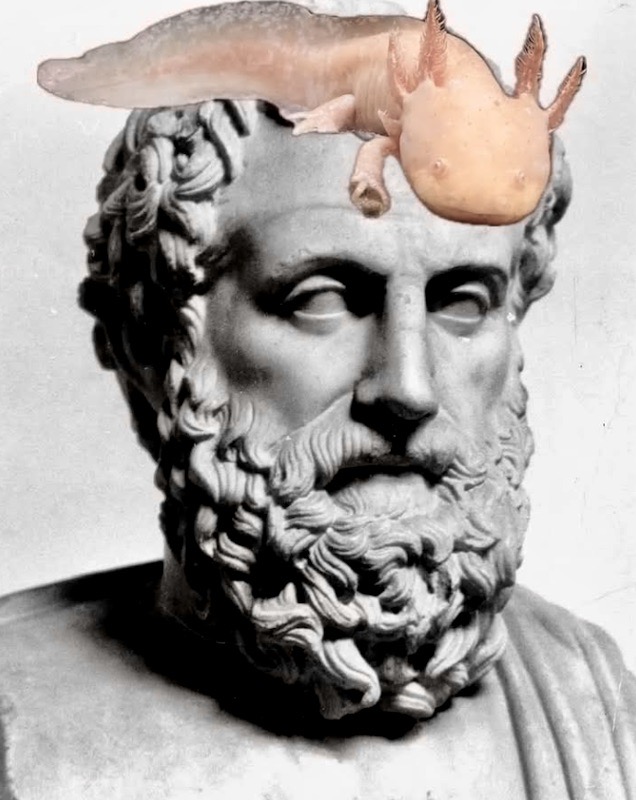
An implied riddle, the solution to which is:
axolotl on Aristotle
Ok, two things here: elfshelfisms and axolotls. (I’m assuming you know, at least in a general way, about Socrates, Plato, and Aristotle. Aristotle was an industrious, though not always entirely accurate, cataloguer of creatures, but since he knew nothing about Mexico (or any part of the Americas), he couldn’t possibly have known about a rare Mexican salamander.)
Elfshelfisms. My 12/22/22 posting “Elfshelfisms” discourses on this riddle form presented visually (with the accompanying script You’ve heard of elf on the shelf, get ready for [image]”), turning on unlikely pairings of X on Y, for rhyming or half-rhyming X and Y: lemur on a femur, Dolly [Parton] on a tamale, sonorants on cormorants, and many many more. The more arcane X and Y are, the better. The animal name axolotl is a really fine X.
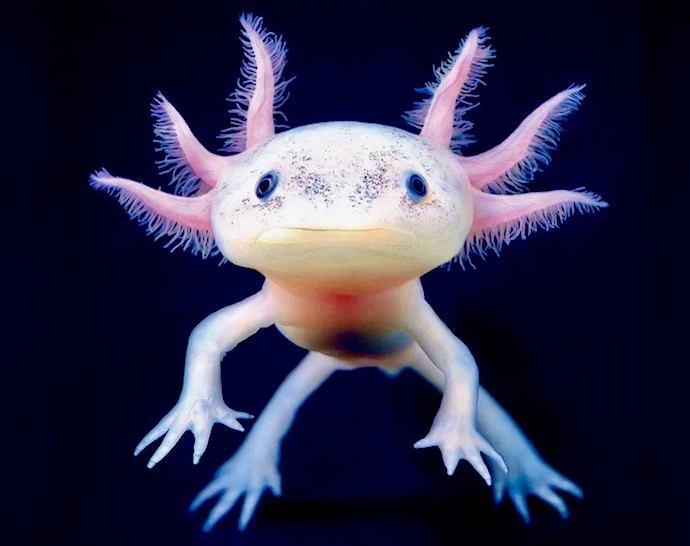
Axolotls. But it turns out that axolotls are no longer obscure in the popular imagination. They are still, however, remarkable, and rare (now, indeed, threatened with extinction in the wild). And, as I noted above, utterly without any association with Aristotle.
I have known about axolotls since the 1950s, when Mad magazine was responsible for potrzebie as a non sequitur nonsense word, ferschlugginer as a sort of all-purpose modifier of negative affect, … and axolotl as a nonsense reference. Being a bookish teenager, and interested in animals of all sorts (this was around the time when I became aware of that excellent creature the capybara), I of course looked axolotl up in my World Book Encyclopedia and was delighted to discover an extraordinary Mexican salamander.
These days, axolotls are international news. In fact, The Economist has a holiday special story on them in the 12/21/24 issue (the on-line story is dated 12/19/24): “Axolotls: The little tadpole that could”, subtitled “How the axolotl rose from obscurity to global stardom: A tale that unites Alexander von Humboldt, Diego Rivera and Pokémon” (warning: the jaunty tone of this piece gives way to serious concerns about the future, and not just the future of the axolotl):
(#2) A most unlikely creature (Economist photo by Tim Flach)The smog and noise of Mexico City feel a world away as flotillas of trajineras, brightly decorated wooden gondolas, glide up and down the cool canals of Xochimilco. The quiet network of waterways, on the southern edge of Mexico’s hectic capital, was built by the Aztecs long before the Spanish conquest. Farmers still grow kale, tomatoes and chillies on Xochimilco’s islands, though these days most Mexicans know the area as a weekend party spot to escape the heat of the city. Some boats carry troupes of mariachi with trumpets and guitars; others serve as floating cafés.
The peaceful neighbourhood is home to Mexico’s perhaps most famous, and most reclusive, celebrity. The Ambystoma mexicanum, or axolotl, has lived a quiet life in the dark waters of Xochimilco since before the Aztecs established their empire in the Valley of Mexico. With its sludgy-brown, gelatinous little body and dislike of noise, the species of salamander seemed destined for a life of watery obscurity.
Yet the axolotl has become an improbable global megastar. Shops are crowded with cuddly axolotls. Toy axolotls fall out of McDonald’s Happy Meals. Axolotl-themed clothes, jewellery and Christmas decorations flood the pages of craft sites such as Etsy. Real and cartoon versions of the creatures rack up tens of millions of views on YouTube and TikTok and star in video games. How did the axolotl emerge from Mexico’s canals to become a worldwide celebrity?
Axolotls lived happily for a long time in Lake Texcoco, overlooked by the smouldering volcano, Popocatépetl. In around 1300 the Aztecs showed up, looking for a new home. According to myth, a prophecy had told them to set up camp at the place where they saw an eagle perched on a cactus with a snake in its beak. Inconveniently, they eventually sighted such a scene on an island in the middle of Lake Texcoco. Undaunted, the Aztecs built a series of causeways and established the seat of their empire there.
Aztecs got on swimmingly with axolotls, which they named after Xolotl, their god of fire and lightning. True, axolotls sometimes made their way into Aztec meals (they are fatty and rich in protein) and medicine (they are said to make a good cough syrup), but broadly they thrived. This changed with the arrival of the Spanish conquistadors, in the 16th century, who considered the strange-looking axolotl — four fingers, five toes, funny gills — to be a creature that God created on an off day. Worse, the Spanish colonists considered Lake Texcoco dirty and flood-prone and drained most of it, consigning the axolotls to Xochimilco, the one neighbourhood where the old waterways survived.
The comeback of the axolotl has been 200 years in the making. They stealthily began to work their way back into the popular imagination in the 19th century, when they charmed explorers such as Alexander von Humboldt, a German geographer who stopped off in Mexico City and sent axolotl specimens back to Europe. Scientists marvelled at their weird and wonderful attributes. Although the axolotl is a species of salamander, it remains in a state of perpetual tadpolehood, never losing its gills to become a full-time land-dweller. Most prized is its ability to regenerate. If an axolotl loses a limb, it grows the whole thing back; it can even rebuild lost parts of brain tissue.
[And then it conquered popular culture, in Japan because of its cuteness and then in the West in gaming, especially via “Minecraft” (the Economist story misses the earlier Mad magazine connection), and then via its popular adoption as a national symbol of Mexico).]
… Will any of this help save the axolotl? Despite its international fame, its status in the wild is worse than ever. Although plenty of axolotls are bred in captivity for scientific research and, in some places, food, they are on the brink of extinction in Xochimilco, their only natural habitat.
… Protecting the axolotl will mean preserving its wider habitat. In that sense, there is more at stake than the creature itself. The canals where it lives protect Mexico’s capital from climate change, by buffering temperatures and conserving water. “If we lose the axolotl, we lose Xochimilco. And if we lose Xochimilco, Mexico City will be vulnerable,” says [Luis Zambrano of the National Autonomous University of Mexico, who is carrying out a census of the creatures]. The race is on to save the creature in its natural habitat. The axolotl is already as popular as the mythical unicorn. The next few years will determine whether it becomes as rare in the wild.
January 5, 2025 at 2:43 pm |
My grandson and his parents were axolotls for Halloween. Can’t post a picture. Maybe send you one in email. “Blizzard” here– almost 1/16th” of snow.
January 5, 2025 at 3:50 pm |
I look forward to seeing the Halloween axolotls.
January 6, 2025 at 8:04 am |
As you may not be surprised to learn, my thoughts also went to Mad magazine as soon as I saw the word. I particularly remember fragments of a parody of Wordsworth’s Daffodils, which begins:
I wandered lonely as a clod,
Picking up old rags and bottles,
When suddenly I saw [forgotten],
A [something] crowd[?] of axolotls…
January 6, 2025 at 8:37 am |
I was sure that your thoughts would have gone right to Mad, but thanks for the reminder about the axolotl poem, which I’ll post about separately (so I can reproduce the poem as it appeared on the page in 1958).
January 6, 2025 at 10:27 am |
When I started using Firefox Relay a year or two ago — it provides an email address you can use (and shut off at any time) for any place you don’t want to use your real address — I set it up so that any mail sent to any_name@ptrzb.mozmail.com comes to me. I was a tiny bit surprised that the subdomain was still available, but it was and it’s something I have no trouble remembering.
(This is a for-pay service – the free version works fine but you can’t use a subdomain and can have fewer relay addresses.)
January 6, 2025 at 5:08 pm |
So I googled elfshelfisms and it lists your blog as the source. LOL
January 6, 2025 at 6:09 pm |
Well, yes, guffaw. But what I’m responsible for is the *name* elfshelfism. The *thing* — the riddle format — I did not devise . But you knew that.