From the annals of eccentric wine naming, the remarkable
Vampire® Coffin & Cape Red Wine Trilogy

from Vampire Vineyards.
From the annals of eccentric wine naming, the remarkable
Vampire® Coffin & Cape Red Wine Trilogy
from Vampire Vineyards.
As soon as the sun rose on November 1st — All Saints Day — the Christmas music began. All of it, including the two monumentally maddening hammer-stroke repetitive songs “The Twelve Days of Christmas” and “The Little Drummer Boy”. My first thought for a remedy — a bullet to the brain to everyone who plays either song in public (everyone is welcome to play them behind closed doors, with effective acoustic insulation in place, of course; I am not an uncivilized monster) — turns out to be not only illegal, but also immoral; no matter what the provocation, aesthetic violence, especially of the fatal variety, apparently offends the sensibilities of our society.
So I propose a different remedy: removing miscreants from the public sphere, cordoning them off where their songs can no longer disrupt people of good will, while meting out a punishment that truly fits the crime. Not aesthetic execution, but aesthetic imprisonment:
A Mick Stevens cartoon, from the 8/17/81 issue of the New Yorker
The background, from my 11/24 posting “Work weeks”:
Back when I still had an academic life, 60 hours a week was the absolutely standard work week, combining teaching, teaching prep, research, publication, preparing and delivering public lectures (see the alarming record of these in yesterday’s posting “Scholarly communication”), and extensive service to the university and the profession.
This is about that extensive service to the university and the profession. Which is chronicled in my giant c.v., along with the teaching and public lectures; once again, the record of enormous amounts of real work, especially reviewing applications for grants from the NSF, NEH, and the Fulbright Program:
Briefly noted. Lynneguist on Facebook today tracked her work weeks: typically 45 hours, rising to 60 at this point in the fall. I reported:
Back when I still had an academic life, 60 hours a week was the absolutely standard work week, combining teaching, teaching prep, research, publication, preparing and delivering public lectures (see the alarming record of these in yesterday’s posting “Scholarly communication”), and extensive service to the university and the profession. My man Jacques took on himself the burdens of seeing that I kept close to the 60-hour week; of preventing me from allowing commitments to take me towards 70- and 80-hour weeks (which he viewed, probably correctly, as dangerous to my health); and of acting as my helpful assistant. That was a great gift of love, offered in the gentlest way — but with an iron fist inside that velvet glove.
In an old NCIS episode (“Bikini Wax”, S2 E15, 3/29/05), the chief medical examiner Dr. Donald “Ducky” Mallard (played by David McCallum) recollects that he’d considered a career in teaching but didn’t find the idea of lecturing on esoteric subjects attractive. Chacun a son goût and all that, but (resisting every digression beckoning me to another profession) I happily signed up to do just that when I was a graduate student at MIT, and went on to appointments at three universities (UIUC, OSU, and Stanford), with visiting teaching gigs at dozens of other institutions over the years.
With the responsibility of teaching, my positions came with a parallel responsibility to engage in research — and to report on that research, not only in writing but also in public presentations, where work in progress can gather useful critiques, and where completed work can be broadcast to new audiences. Face-to-face interaction, in a classroom or in a lecture room, is irreplaceable for scholarly communication, because it’s interactive and can be adjusted on the spot to fit the needs of the moment.
For years now, these interactions haven’t been available to me, so I’ve had to find interactive forms of scholarly communication in different modes: blogging on the internet (inviting commentary) and using social media. More popular and less esoteric, but still in their own ways pedagogical.
Thanks to Ducky Mallard for spurring me to go back to my great big c.v. that has everything in it, to look at the summary of what I did by way of scholarly communication in my previous life. I find it incredibly hard to believe that I was that person, but here’s the evidence.
Yesterday, a news story (from an Ohio site) with this summary of its subject, Madelyn Varela:
Ohio’s viral lesbian cheesemonger
This builds in sound from its onset to its cheesemonger climax, which was something of a surprise (just on likelihood, I was expecting goatfarmer); and its content comes across like a series of random pings: Ohio; then a lot of followers (viral here means, roughly ‘widely circulated, with many followers’); then, whoa, a dyke; and, who would have guessed, a seller of cheese (in a word, a cheesemonger). A lovely bit of found poetry.
So, of course, I gilded it.
Tomorrow is 11/22; on my calendar this brings up a set of two deeply discordant anniversaries and the birthday of an admirable colleague and friend. And this year 11/22 is the date of Stanford’s preeminent sporting event, to add a note of passionate silliness to the whole business.
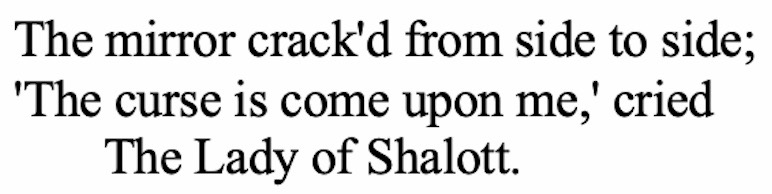
(#1) Alfred Tennyson,”The Lady of Shalott” (1832)
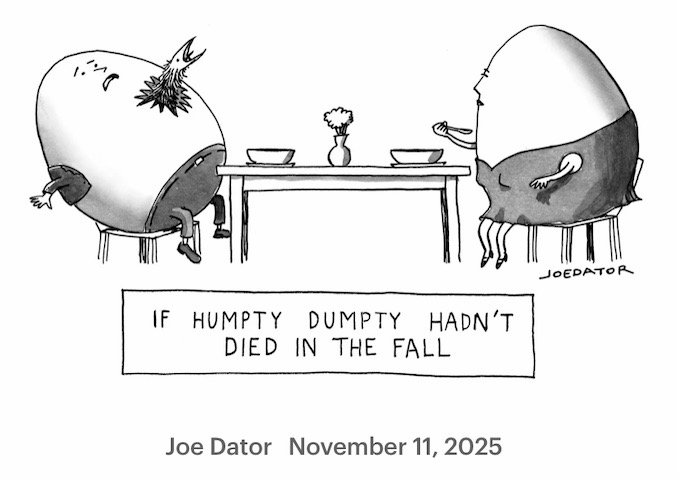
A Joe Dator cartoon in the latest (11/24/25) print issue of the New Yorker poses the question, “What if Humpty Dumpty had survived his fall?”
Humpty Dumpty is an egg. An egg contains a developing chicken embryo. The embryo will eventually mature, crack through the egg, and emerge as a chick. (There is even theme music for this scenario, Mussorgsky’s “Ballad of the Unhatched Chicks / the Chicks in their Shells”, from “Pictures at an Exhibition”.)
JD shows the first moment of emergence, the chick’s head bursting through the chest of a dismayed Humpty Dumpty, who is toppling backwards in his chair — a scene that will be viscerally painful for modern audiences familiar with the 1979 movie Alien, with its famously grotesque Chestbuster scene, but will in any case evoke a fatal heart attack :
(#2) Humpty Dumpty and his female companion at table, when the mortal wound opens up; it will crack him from side to side
Another chapter in foraging for food by restaurant delivery. I had a desire for some gyros, an old favorite in the wide world of demotic cuisines, in this case Greek: from Merriam-Webster online (considerably amended):
noun gyro (plural gyros): /jíro/ [North American] a sandwich especially of lamb and beef [roasted on a spit and sliced], tomato, onion, and yogurt sauce [tzatziki] on pita bread [AZ: the name comes originally from Greek, but has been thoroughly Anglicized, so that the phonology and morphology of the Greek name are no longer relevant to the American name]