Having just posted on Pad Thai, I should have realized that the inevitable techie phrasal overlap portmanteau (or POP) would have cropped up: iPad Thai. And so it has.
Archive for 2012
The inevitable POP
July 18, 2012Pad Thai
July 18, 2012From Arne Adolfsen on Facebook, a link to a piece by food writer Alexandra Greeley in Gastronomica: The Journal of Food and Culture: “Finding Pad Thai”, which begins:
For many westerners, pad Thai—or, more accurately, kway teow pad Thai (stir-fried rice noodles Thai-style)—symbolizes Thai cooking, thanks in large part to the Thai government’s ongoing efforts to introduce the country’s food to the rest of the world. The campaign has been resoundingly successful…
If Westerners believe that pad Thai symbolizes Thai cooking, many Thais agree [and judge Thai restaurants around the world by this dish] … [But in Thailand itself] many restaurants choose not to compete with the street-food vendors, who make and serve only pad Thai all day long and thus have perfected the recipe.
Pad Thai is really nothing more than a regular noodle dish, one that is not even native to Thailand. Its full name, kway teow pad Thai, hints at its possible Chinese origins; kway teow, in Chinese, refers to rice noodles. It is likely that some early version of the dish came to Thailand with settlers crossing from southern China, who brought their own recipe for fried rice noodles.
… Prime Minister Pibulsonggram [Phibunsongkhram in Wikipedia, Phibunsonkhram in OED3; known as Phibun] … is universally credited with having popularized today’s pad Thai recipe by codifying, and perhaps even creating, it.
On the one hand, Greeley says that Pad Thai is “not even native to Thailand”, but on the other, she recognizes that today’s recipe is a specifically Thai creation. There’s no real contradiction here: most dishes have some history taking them back (usually in somewhat different, even rudimentary, form) to places and cultures other than the one they’re now associated with.
You’re not the Boss of me!
July 18, 2012Today’s Bizarro:
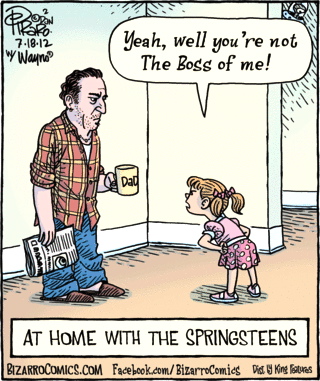
A pun on boss, used here in the childish formula You’re not the boss of me! and also in Bruce Springsteen’s nickname The Boss.
unique from
July 17, 2012Come across on the net a while back:
The 36th Street station in Brooklyn has one tiny flaw that sets it apart from all the other subway stations in the city: One of its stairs “is a fraction of an inch higher” than the rest. (link)
No problem there. But the accompanying video has the caption:
Something that makes it unique from any other subway station in the city.
And to my surprise, “makes it unique from” gets thousands of raw ghits, as do other predicative uses of unique from ‘different / distinct / distinguished / separate from’. So unique (with its semantics of separation or distinction) has, for some speakers, picked up the syntax of different — in more than this respect, it turns out.
Cooties
July 17, 2012A Tom the Dancing Bug cartoon by Ruben Bolling, caught yesterday in Funny Times (which was reprinting it from April):
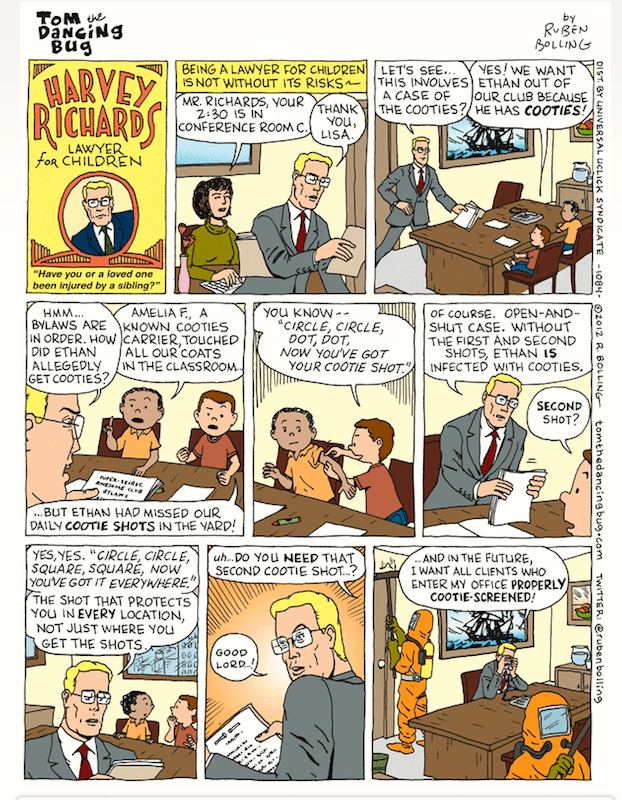
Many guffaws, especially at the last panel, with its hazmat decontamination team.
Cooties are part of the popular lore of childhood (at least in the U.S.), with an interesting linguistic history.
More dubious portmanteaus
July 17, 2012The world of portmanteaus is crowded with playful formations that are unlikely to survive for long (Higgsteria), including many that are just for ostentatious display (Piranhaconda and Sharktopus). Then there are those that appear to be meant to be useful, but are awkward and unlikely to succeed: for instance the dubious portmanteaus Innovatrium, womance (and femily), and twunk. Two more have recently been logged on ADS-L: mediot(s) and preglimony.
Unprovoked subject whomever
July 17, 2012From Scott Horsley on NPR’s Weekend Edition Saturday last weekend (July 14th):
Republicans are fighting just as hard for Virginia, believing, as Mr. Obama does, that whomever wins the state will have a good chance of winning the White House.
A “free relative” clause whomever wins the state serving as the subject of a that-complement clause. Within the free relative, whomever is serving as the subject (despite its accusative case); standard English has
that whoever wins the state will have a good chance … [subject clause underlined]
“that whoever wins the state” outnumbers “that whomever wins the state” in ghits 10 to 1 — roughly 60 examples to 6, when irrelevancies and duplicates are omitted — but whomever occurs as a complement subject surprisingly often, and in the writing of experienced writers in serious contexts. These examples are the -ever parallel to the “unprovoked subject whom” cases I talked about in an earlier posting.
Labiates
July 16, 2012A follow-up to my previous posting on Melissa (and Monarda), plants in the labiate (Lamiaceae) family, with a bow back to an earlier posting on labiates, especially coleus (Solenostemon). These are favorite plants of mine — admittedly, as commenter “beslayed” said about my previous posting, tough and invasive plants, but affording scent, taste, and good ground cover (and they can always be hacked back from one another). They were mainstays of my Columbus OH garden (some description here).
The buzz on Melissa
July 16, 2012The summer intern on the language of comics project is named Melissa, and I grow the scent-herb lemon balm (Melissa officinalis), so I thought this would be a good occasion for a little posting on words and plants.
Data points: plurals in compounds 7/16/12
July 16, 2012A brief follow-up to my posting of 12/5/10 on plurals in compounds (schools chief / superintendent / administrator, comments spam, jobs market), inspired by a posting to ADS-L by Jon Lighter this morning:
A Romney spokesman says in CNN that in three-and-a half years in office, the President “hasn’t even moved the needle” on “jobs creation.”
In my day, that would have been “*job* creation.”
My earlier posting noted a collection of cases where compounds with Npl first element alternated with compounds with a bare-stem N (interpreted semantically as plural) as first element; alongside the examples cited above are: school chief / superintendent / administrator, comment spam, job market. And so it is with jobs creation, jobs creators, and jobs growth.